

01 / SPECIES PROFILE
Species Overview
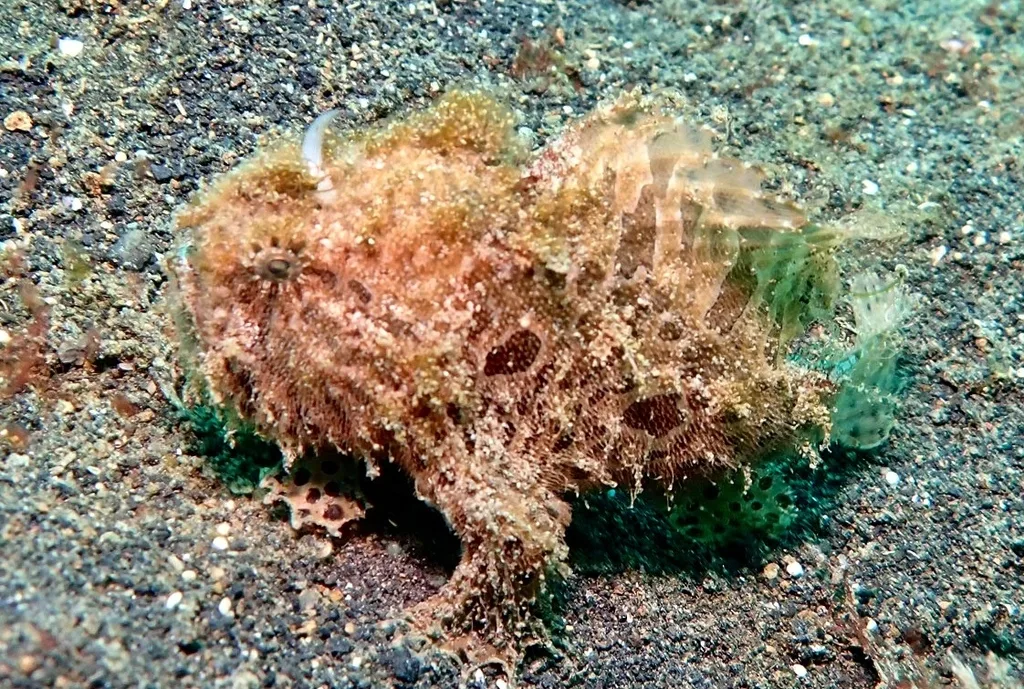
Short, globe-shaped frogfish with rough skin; head, body and fins are covered with dark, parallel streaks; the lure is no longer than the second dorsal spine. Some individuals grow long hair-like skin filaments
- Family
- Antennariidae
- Size
- Maximum recorded 25 cm TL (10 in); commonly 10 cm TL (4 in); heaviest published weight 32.90 g.
- Depth range
- 10-219 m, usually to 40 m.
- Habitat
- Rocky and coral reefs on rock, sand or rubble; also weedy estuaries.
- Diet
- Small fishes and crustaceans lured within reach ( family notes).
- Geographic range
- Worldwide in warm seas; western Atlantic from New Jersey and Bermuda through the Caribbean to southern Brazil.
- Maximum weight
- 32.9 g
- Trophic level
- 4.2
- Vulnerability index
- 13.16
- Human hazard
- Harmless
- Reproductive mode
- Separate sexes; External fertilization; Eggs or young are not guarded; Eggs scattered in open water or on the substrate
- Common name in Spanish
- Pescador, Ranisapo estriado
02 / NATURAL HISTORY
Field notes
Biology and ecology, shown where information is available for this species.
Camouflaged ambush predator of small fishes.
Bottom-dwelling ambush predator; can inflate itself like a puffer.
Lays eggs in a ribbon or raft of jelly; males are more brightly colored and have longer skin flaps than females.
Longlure frogfish (Antennarius multiocellatus): has eyespots instead of streaks and a much longer lure.
LC – Least Concern.
Recorded food groups and items (3)
- nekton
- finfish
- bony fish
Reported countries and territories (22)
- Bahamas
- Barbados
- Belize
- Bermuda
- British Virgin Islands
- Colombia
- Cuba
- Curaçao
- French Guiana
- Grenada
- Guyana
- Haiti
- Jamaica
- Martinique
- Mexico
- Panama
- Puerto Rico
- Saint Vincent and the Grenadines
- Suriname
- Trinidad and Tobago
- United States Virgin Islands
- Venezuela
TL means total length; SL excludes the tail fin; FL measures to the tail fork. These measurements are not interchangeable.
CARIBBEAN REEF FISH FOUNDATION
From field knowledge
to reef action.
Explore the Foundation’s current conservation and research work.