

01 / SPECIES PROFILE
Species Overview
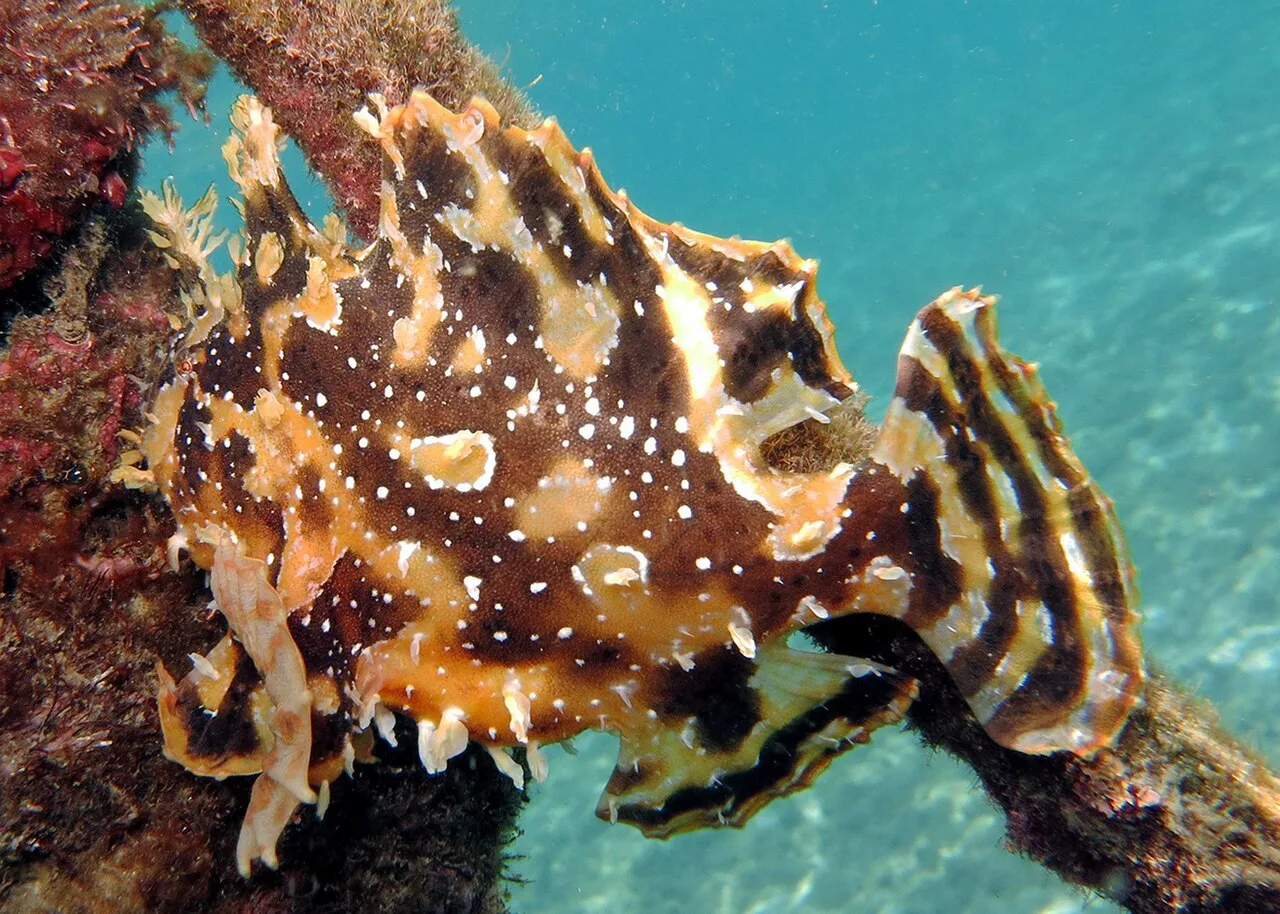
Mottled yellow, olive and brown frogfish with many leafy skin flaps that copy floating seaweed; smooth skin and long, arm-like pelvic fins
- Family
- Antennariidae
- Size
- Maximum recorded 20 cm TL (8 in).
- Depth range
- 0-50 m, usually 0-2 m.
- Habitat
- Near the surface among floating Sargassum and other drifting objects; storms often blow it toward shore.
- Diet
- Small fishes and shrimps that shelter in the floating weed.
- Geographic range
- Warm seas worldwide except the eastern Pacific; in the western Atlantic from Canada to Uruguay. Listed for the US Virgin Islands by
- Trophic level
- 3.93
- Vulnerability index
- 10
- Human hazard
- Reports of ciguatera poisoning
- Reproductive mode
- Separate sexes; External fertilization; Eggs or young are not guarded; Eggs scattered in open water or on the substrate
- Common name in Spanish
- Pez sargazo, Rana, Sapo
- Common name in French
- Antennaire des Sargasses, Baudroie, Pêcheur des Sargasses, Poisson-pêcheur des Sargasses
02 / NATURAL HISTORY
Field notes
Biology and ecology, shown where information is available for this species.
Top predator of the floating Sargassum community.
Solitary, aggressive predator that clambers through the seaweed using its fins like hands.
Pairs rush to the surface to spawn; eggs are released in a floating jelly raft and stay in it until they hatch.
Reef frogfishes (Antennarius spp.): live on the bottom and lack the many leafy flaps.
LC – Least Concern.
Recorded food groups and items (10)
- Kyphosus sp.
- nekton
- finfish
- bony fish
- Histrio histrio
- zoobenthos
- benthic crust.
- zooplankton
- planktonic crust.
- planktonic copepods
Reported countries and territories (13)
- Bahamas
- Bermuda
- Cayman Islands
- Cuba
- Curaçao
- French Guiana
- Guyana
- Jamaica
- Martinique
- Mexico
- Puerto Rico
- Suriname
- United States Virgin Islands
TL means total length; SL excludes the tail fin; FL measures to the tail fork. These measurements are not interchangeable.
CARIBBEAN REEF FISH FOUNDATION
From field knowledge
to reef action.
Explore the Foundation’s current conservation and research work.