

01 / SPECIES PROFILE
Species Overview
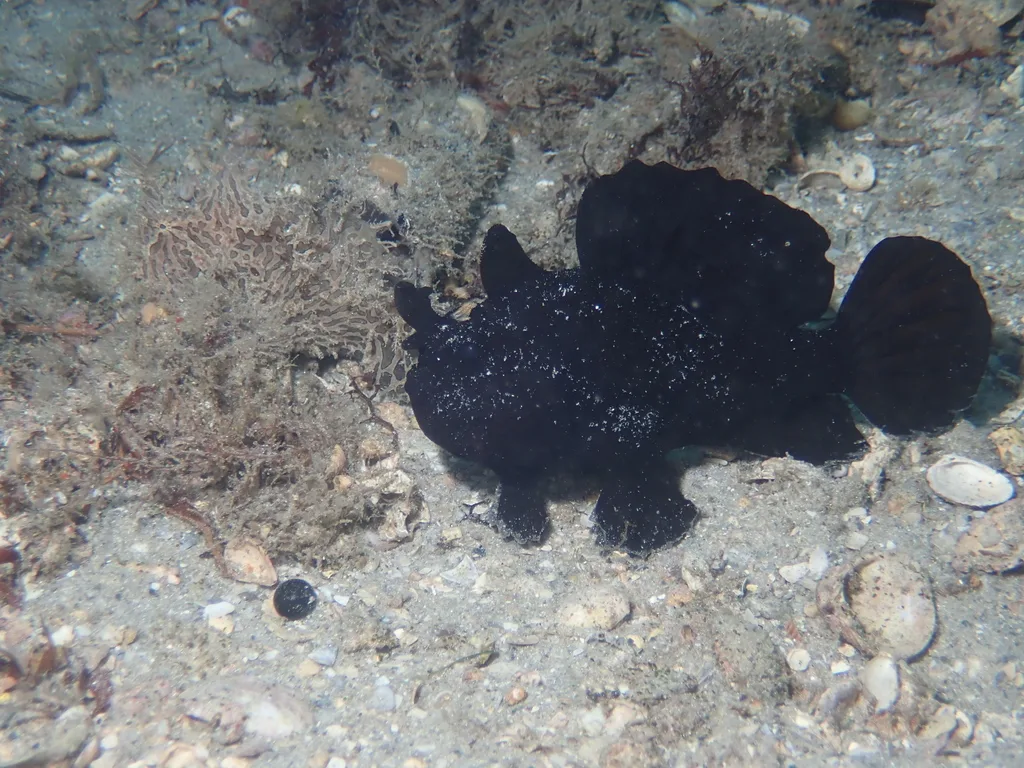
A round-bodied frogfish with rough skin, a large upturned mouth and pectoral fins shaped like jointed arms. Color varies from pale or yellow to green, brown or gray, usually with irregular dark lines and spots; its lure divides into two short, worm-like branches
- Family
- Antennariidae
- IUCN Red List category
- Least Concern
- Size
- Up to 20 cm (8 in); A. scaber page gives no length.
- Depth range
- 10–90 m; 10–219 m.
- Habitat
- Marine and brackish, reef-associated, subtropical.
- Diet
- Diet includes bony fishes and bottom-dwelling crustaceans.
- Geographic range
- Caribbean: Bahamas, Greater and Lesser Antilles, Virgin Islands, western Caribbean. Wider: western Atlantic incl. Bermuda, Florida Keys, Gulf of Mexico and northern and southern South America.
- Vulnerability index
- 10.33
- Human hazard
- Harmless
02 / NATURAL HISTORY
Field notes
Biology and ecology, shown where information is available for this species.
Predator; estimated trophic level 4.2.
Island Frogfish has a tapering, filamented lure and a fishing rod shorter than its second dorsal spine. Splitlure Frogfish has two short, worm-like lure branches, a rod about as long as the second spine, and a straighter second spine joined to the head by a smooth membrane.
LC – Least Concern. Used in subsistence fisheries; fishing vulnerability low. No specific protections found.
Reported countries and territories (14)
- Bahamas
- Bermuda
- British Virgin Islands
- Cayman Islands
- Colombia
- Cuba
- French Guiana
- Guyana
- Haiti
- Jamaica
- Puerto Rico
- Suriname
- Trinidad and Tobago
- Venezuela
TL means total length; SL excludes the tail fin; FL measures to the tail fork. These measurements are not interchangeable.
CARIBBEAN REEF FISH FOUNDATION
From field knowledge
to reef action.
Explore the Foundation’s current conservation and research work.