
01 / SPECIES PROFILE
Species Overview
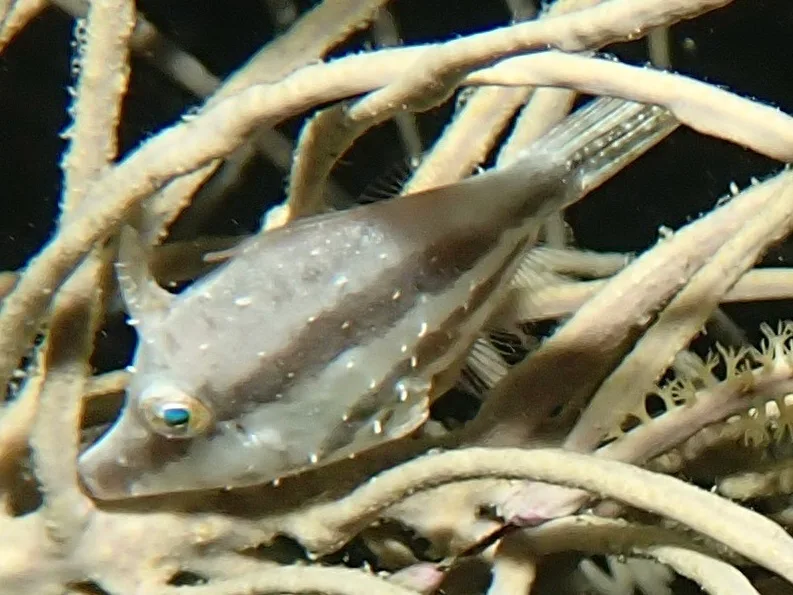
Small, slender filefish (body depth about 3 times in SL) with a long concave facial profile; brownish gray with scattered small black spots; dorsal fin 2 spines and 32–37 soft rays, anal 31–36 soft rays
- Family
- Monacanthidae
- IUCN Red List category
- Least Concern
- Size
- Typical adult 5–8 cm (2–3 in); maximum 10 cm TL (3.9 in).
- Depth range
- 3–18 m; 2–50 m.
- Habitat
- Reef-associated over sandy and rocky bottoms; drifts among gorgonians.
- Diet
- Algae and invertebrates.
- Geographic range
- Bahamas, Caribbean, Florida, Bermuda and Gulf of America; Western Atlantic from North Carolina and Bermuda to the Antilles and northern South America.
- Vulnerability index
- 14.62
- Human hazard
- Harmless
- Common name in Spanish
- Chivo, Cholita, Lija reticulada, Pez ballesta
02 / NATURAL HISTORY
Field notes
Biology and ecology, shown where information is available for this species.
Small omnivore feeding on algae and invertebrates among gorgonians.
Drifts among gorgonians.
Planehead Filefish (Stephanolepis hispidus) is short and deep-bodied and larger (to 36.9 cm TL), unlike the slender body of the Slender Filefish.
LC – Least Concern.
Reported countries and territories (26)
- Anguilla
- Antigua and Barbuda
- Aruba
- Bahamas
- Barbados
- Belize
- Bermuda
- British Virgin Islands
- Cayman Islands
- Cuba
- Curaçao
- Dominica
- Dominican Republic
- Grenada
- Guadeloupe
- Haiti
- Jamaica
- Martinique
- Montserrat
- Puerto Rico
- Saint Kitts and Nevis
- Saint Lucia
- Saint Vincent and the Grenadines
- Trinidad and Tobago
- Turks and Caicos Islands
- United States Virgin Islands
TL means total length; SL excludes the tail fin; FL measures to the tail fork. These measurements are not interchangeable.
CARIBBEAN REEF FISH FOUNDATION
From field knowledge
to reef action.
Explore the Foundation’s current conservation and research work.