
01 / SPECIES PROFILE
Species Overview
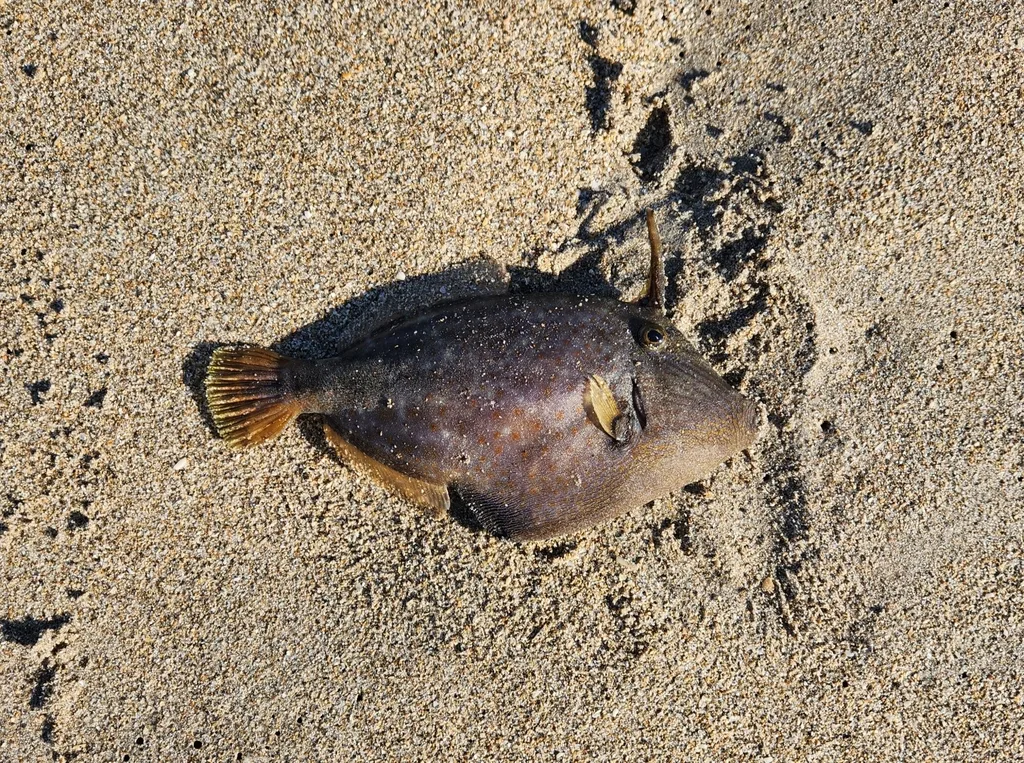
Short, deep-bodied filefish with small scattered orange spots (many brown-centered) and whitish spots of similar size; head with dull yellow lines toward the snout alternating with bluish lines near the eye; first dorsal spine over the eye folds into a deep groove; dorsal fin 2 spines and 33–36 soft rays, anal 29–32 soft rays
- Family
- Monacanthidae
- IUCN Red List category
- Least Concern
- Size
- Typical adult 10–18 cm (4–7 in); common length 14 cm TL (5.5 in), maximum 20 cm TL (7.9 in).
- Depth range
- 5–18 m; 3–50 m, usually 3–20 m.
- Habitat
- Shallow coral and rocky reefs; stays near the bottom, hiding among gorgonians and branching coral.
- Diet
- Mainly sponges and algae; stomachs often contain tunicates, bryozoans and other sessile invertebrates.
- Geographic range
- Caribbean, Bahamas, Florida, Gulf of America and Bermuda; Western Atlantic from Massachusetts and Bermuda through the northern Gulf to southeastern Brazil; eastern Atlantic at São Tomé and the Gulf of Guinea.
- Trophic level
- 2.9
- Vulnerability index
- 24.95
- Human hazard
- Reports of ciguatera poisoning
- Common name in Spanish
- Cachúa chola, Chivo, Lija, Lija colorada, Lija falsa, Lija pintada, Pereza
- Common name in French
- Bourse pintade
02 / NATURAL HISTORY
Field notes
Biology and ecology, shown where information is available for this species.
Young are pelagic and are important prey for tunas and billfishes
Grazer of sponges, algae and sessile invertebrates; pelagic young are prey for tunas and billfishes.
Bottom-oriented, sheltering among gorgonians and branching coral.
Whitespotted Filefish (Cantherhines macrocerus) is much larger (to 46 cm TL), brown with prominent white spots and lacks the orange spotting.
LC – Least Concern. subsistence fisheries and aquarium trade, generally considered a trash fish.
Recorded food groups and items (9)
- Sargassum
- plants
- other plants
- benthic algae/weeds
- zoobenthos
- other benthic invertebrates
- sponges/tunicates
- ascidians
- sponges
Reported countries and territories (37)
- Anguilla
- Antigua and Barbuda
- Aruba
- Bahamas
- Barbados
- Belize
- Bermuda
- British Virgin Islands
- Cayman Islands
- Colombia
- Costa Rica
- Cuba
- Curaçao
- Dominica
- Dominican Republic
- French Guiana
- Grenada
- Guadeloupe
- Guatemala
- Guyana
- Haiti
- Honduras
- Jamaica
- Martinique
- Mexico
- Montserrat
- Nicaragua
- Panama
- Puerto Rico
- Saint Kitts and Nevis
- Saint Lucia
- Saint Vincent and the Grenadines
- Suriname
- Trinidad and Tobago
- Turks and Caicos Islands
- United States Virgin Islands
- Venezuela
TL means total length; SL excludes the tail fin; FL measures to the tail fork. These measurements are not interchangeable.
CARIBBEAN REEF FISH FOUNDATION
From field knowledge
to reef action.
Explore the Foundation’s current conservation and research work.