
01 / SPECIES PROFILE
Species Overview
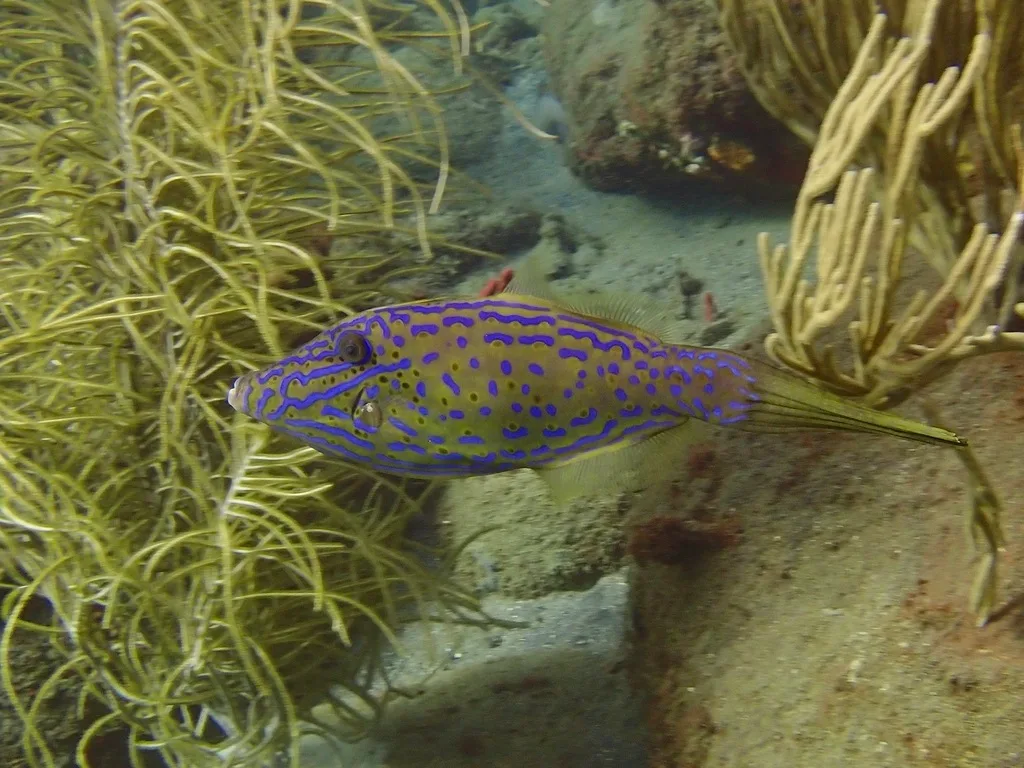
Elongate, flattened oval body with concave snout, small upturned mouth and no pelvic fin; olive brown to gray with irregular blue spots and short lines plus small black spots; long rounded tail often ragged at the edge; dorsal fin 2 spines and 43–50 soft rays, anal 46–52 soft rays
- Family
- Monacanthidae
- IUCN Red List category
- Least Concern
- Size
- Typical adult 30–60 cm (1–2 ft); common length 55 cm TL (22 in), maximum 110 cm TL (43 in) and 2.5 kg.
- Depth range
- 6–18 m; 3–120 m, usually 3–20 m.
- Habitat
- Lagoons and seaward reefs, occasionally under floating objects; adults usually along deep coastal slopes or outer reef drop-offs around 20 m; benthopelagic.
- Diet
- Algae, seagrass, hydrozoans, gorgonians, colonial anemones and tunicates.
- Geographic range
- Circumtropical.
- Maximum weight
- 2.5 kg
- Trophic level
- 3.02
- Vulnerability index
- 67.69
- Human hazard
- Reports of ciguatera poisoning
- Common name in Spanish
- Cachua, Cachúa lija azul, Lija, Lija trompa, Pez lija puntiazul, Puerco de altura, Puerco de lijatrompa, Unicornios
- Common name in French
- Baliste écriture, Bourse écriture, Bourse graffiti, Bourse loulou, Bourse robe-de-cuir, Chien katounou
02 / NATURAL HISTORY
Field notes
Biology and ecology, shown where information is available for this species.
Juveniles yellowish brown with dark spots and drift head-down among floating weed rafts in the open ocean for a long time; adults move to deep coastal slopes and outer reef drop-offs.
Omnivorous grazer of algae, seagrass and sessile invertebrates; prey for larger fishes such as dolphinfish and bluefin tuna.
When threatened it dives into a crevice and locks its head and belly spines to wedge itself in, and rests this way at night. Breeds in harem-like groups of one male with two to five females.
Groups of one male and two to five females; females lay demersal eggs in sheltered spots such as sand depressions, which the male fertilizes; both parents may guard the eggs and the female tends the young after hatching.
Whitespotted Filefish (Cantherhines macrocerus) is deep-bodied with prominent white spots rather than blue lines and spots, and is smaller (to 46 cm TL).
LC – Least Concern. taken in commercial fisheries, as a gamefish and for the aquarium trade.
Recorded food groups and items (10)
- Sargassum
- plants
- other plants
- benthic algae/weeds
- zoobenthos
- benthic crust.
- amphipods
- Physalia sp.
- zooplankton
- jellyfish/hydroids
Reported countries and territories (32)
- Anguilla
- Antigua and Barbuda
- Aruba
- Bahamas
- Barbados
- Belize
- British Virgin Islands
- Cayman Islands
- Colombia
- Costa Rica
- Cuba
- Curaçao
- Dominica
- Dominican Republic
- Grenada
- Guadeloupe
- Guatemala
- Haiti
- Honduras
- Jamaica
- Martinique
- Mexico
- Montserrat
- Nicaragua
- Panama
- Puerto Rico
- Saint Kitts and Nevis
- Saint Lucia
- Saint Vincent and the Grenadines
- Trinidad and Tobago
- Turks and Caicos Islands
- United States Virgin Islands
TL means total length; SL excludes the tail fin; FL measures to the tail fork. These measurements are not interchangeable.
CARIBBEAN REEF FISH FOUNDATION
From field knowledge
to reef action.
Explore the Foundation’s current conservation and research work.