
01 / SPECIES PROFILE
Species Overview
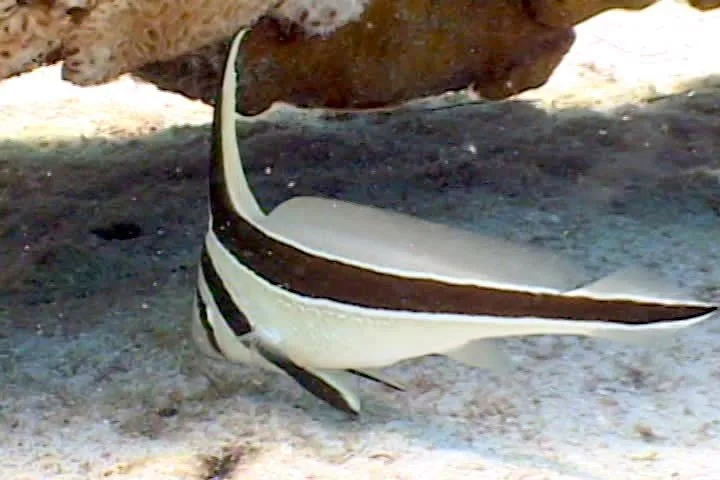
Drum with a very tall, short-based first dorsal fin; gray body with three white-edged dark brown to black bands — one vertical through the eye, one from the nape over the gill cover and chest, and one from the tall dorsal fin curving back to the tip of the tail; 13 dorsal spines and 47–55 soft rays
- Family
- Sciaenidae
- Size
- Typically 12–23 cm (5–9 in); common length 15 cm TL (6 in); maximum recorded 25 cm TL (10 in).
- Depth range
- 12–43 m; 10–60 m.
- Habitat
- Bays and sounds and deep coral reefs.
- Diet
- Mainly small shrimps and crabs, plus polychaete and snails.
- Geographic range
- Caribbean: Published accounts list the Caribbean, Bahamas, Florida, Gulf and Bermuda, with. Wider Atlantic: Bermuda and North Carolina to Rio de Janeiro, Brazil.
- Trophic level
- 3.5
- Vulnerability index
- 23.05
- Human hazard
- Reports of ciguatera poisoning
- Reproductive mode
- Separate sexes; External fertilization; Eggs or young are not guarded; Eggs scattered in open water or on the substrate
- Common name in Spanish
- Gligli, Guapena, Obispo coronado, Obispo listado, Payasito obispo, Serrana, Vaqueta, Vaqueta de cinta, Verdugo
- Common name in French
- Évêque couronné
02 / NATURAL HISTORY
Field notes
Biology and ecology, shown where information is available for this species.
shows a juvenile stage; juveniles sometimes occur inshore
Small predator of benthic crustaceans and (trophic level about 3.4,).
Easily approached by divers
Oviparous; has been reared in captivity.
Jackknife-fish (Eques lanceolatus): 3 oblique bars with no pes; fins pale with no spots; juvenile has a line on the snout and a final bar extending from the dorsal fin to the tail fin. Blackbar Drum (Pareques iwamotoi): broad bar across eyes; broad bar from first dorsal fin to pelvic fins; thin mid-flank pe; spiny dorsal fin relatively high; juvenile features match adult with an additional snout bar. Spotted Drum (Eques punctatus): 3 oblique bars and pes; spotted dorsal, anal, and tail fins; juvenile has an oval spot on the snout and a black pe on the pectoral fin. High-hat (Pareques acuminatus): white with 3-5 broad and narrow alternating pes; high spiny dorsal fin; juvenile has a bar between eyes, 2 spots on the snout, and a black pectoral fin.
LC – Least Concern; minor commercial fishery and aquarium trade
Recorded food groups and items (2)
- zoobenthos
- other benthic invertebrates
Reported countries and territories (33)
- Anguilla
- Antigua and Barbuda
- Aruba
- Bahamas
- Barbados
- Belize
- Bermuda
- British Virgin Islands
- Cayman Islands
- Colombia
- Cuba
- Curaçao
- Dominica
- Dominican Republic
- French Guiana
- Grenada
- Guadeloupe
- Guyana
- Haiti
- Jamaica
- Martinique
- Mexico
- Montserrat
- Nicaragua
- Puerto Rico
- Saint Kitts and Nevis
- Saint Lucia
- Saint Vincent and the Grenadines
- Suriname
- Trinidad and Tobago
- Turks and Caicos Islands
- United States Virgin Islands
- Venezuela
TL means total length; SL excludes the tail fin; FL measures to the tail fork. These measurements are not interchangeable.
CARIBBEAN REEF FISH FOUNDATION
From field knowledge
to reef action.
Explore the Foundation’s current conservation and research work.