
01 / SPECIES PROFILE
Species Overview
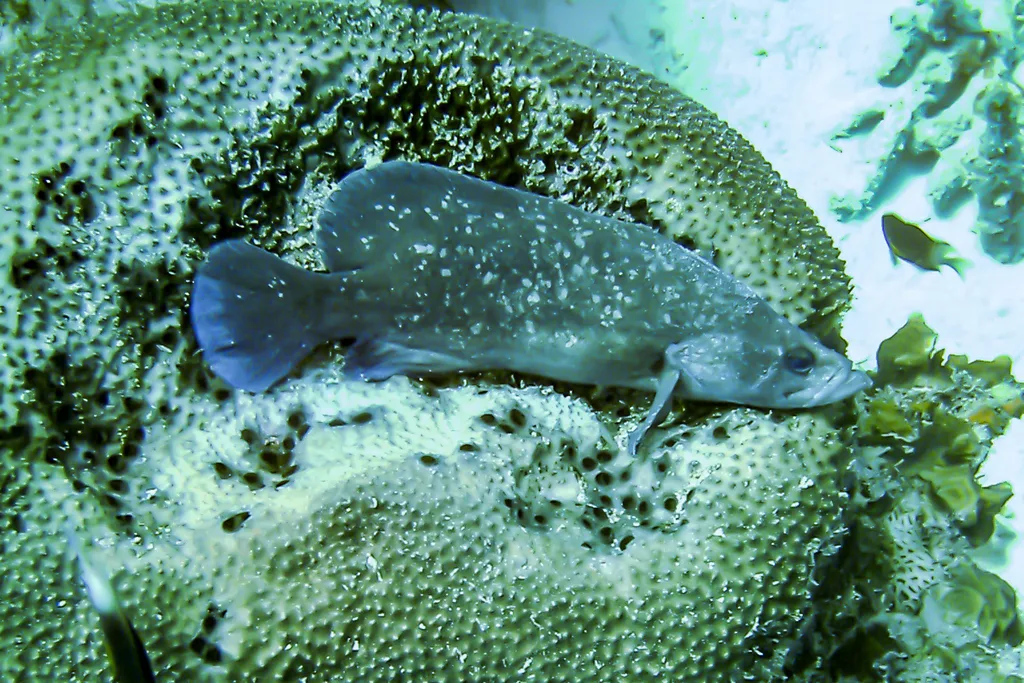
Fusiform, dark-bodied soapfish marked with pale spots about pupil-size or smaller on the body and some on the dorsal fin; 3 dorsal spines and 23–25 dorsal soft rays
- Family
- Grammistidae (soapfishes; Published accounts place the genus in Serranidae)
- IUCN Red List category
- Least Concern
- Size
- Typically 13–25 cm [5–10 in]; common length 25 cm TL [9.8 in], maximum 35 cm TL [13.8 in].
- Depth range
- 1–70 m, usually 2–35 m; 5–18 m typical.
- Habitat
- Reef-associated in shallow water over eroded limestone, mixed sand and rock, and reefs; often near the bases of coral heads and cave mouths.
- Diet
- Predator of other animals (trophic level 4.1 from diet studies)
- Geographic range
- Caribbean, Bahamas, Florida and Bermuda; Western Atlantic from Bermuda and southern Florida to Brazil, and Eastern Atlantic from Mauritania to Angola including oceanic islands.
- Trophic level
- 4
- Vulnerability index
- 18.57
- Human hazard
- Other reported hazard
- Reproductive mode
- Female-to-male sex change (protogyny); Eggs or young are not guarded
- Common name in Spanish
- Jabon, Jabón, Jabón amargo, Jaboncillo, Jaboncillo máximo, Jabonera, Jabonero, Jabonero grande, Pez jabon
- Common name in French
- Grand savon, Poisson savon, Poisson-savon, Savon, Savonnette
02 / NATURAL HISTORY
Field notes
Biology and ecology, shown where information is available for this species.
Nocturnal reef predator (trophic level 4.1); its toxic mucus acts as a chemical defense.
Solitary; nocturnal, often lying motionless against rocks during the day; when disturbed secretes mucus that turns to a soapy foam.
Spotted Soapfish (R. subbifrenatus) and Freckled Soapfish (R. bistrispinus): smaller (to 18 and 15 cm TL) and marked with dark spots, whereas Greater Soapfish has pale spots.
LC – Least Concern. No specific threats documented; fishing vulnerability low.
Recorded food groups and items (5)
- nekton
- finfish
- bony fish
- zoobenthos
- other benthic invertebrates
Reported countries and territories (37)
- Anguilla
- Antigua and Barbuda
- Aruba
- Bahamas
- Barbados
- Belize
- Bermuda
- British Virgin Islands
- Cayman Islands
- Colombia
- Costa Rica
- Cuba
- Curaçao
- Dominica
- Dominican Republic
- French Guiana
- Grenada
- Guadeloupe
- Guatemala
- Guyana
- Haiti
- Honduras
- Jamaica
- Martinique
- Mexico
- Montserrat
- Nicaragua
- Panama
- Puerto Rico
- Saint Kitts and Nevis
- Saint Lucia
- Saint Vincent and the Grenadines
- Suriname
- Trinidad and Tobago
- Turks and Caicos Islands
- United States Virgin Islands
- Venezuela
TL means total length; SL excludes the tail fin; FL measures to the tail fork. These measurements are not interchangeable.
CARIBBEAN REEF FISH FOUNDATION
From field knowledge
to reef action.
Explore the Foundation’s current conservation and research work.