
Groupers & Sea Basses
Nassau Grouper
Epinephelus striatus
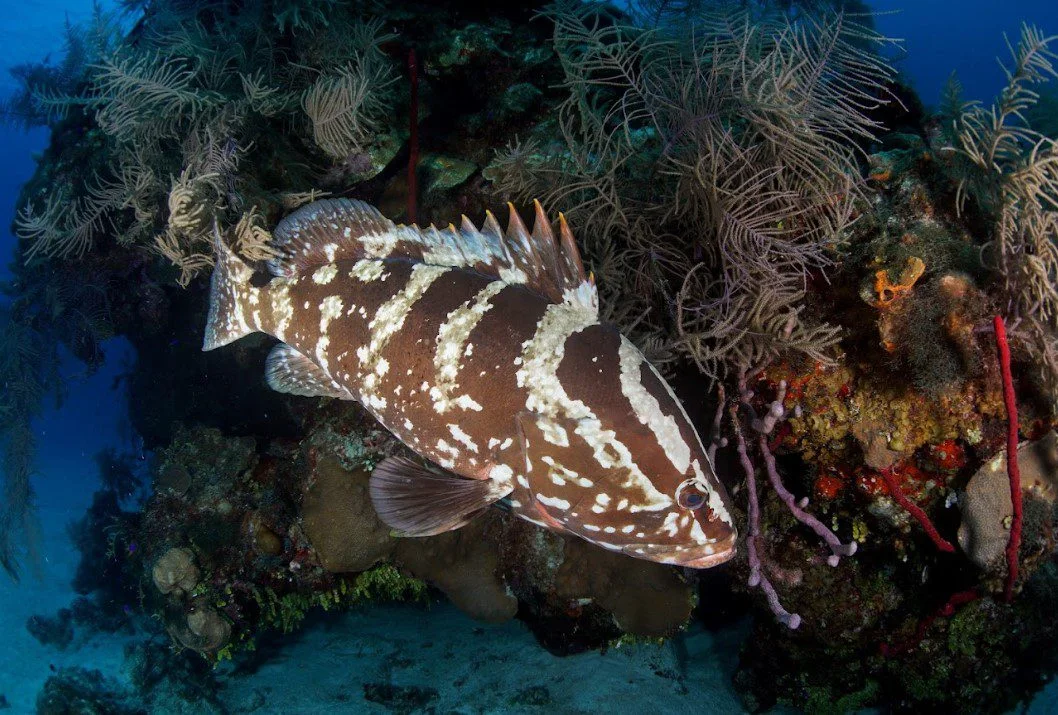
Species Overview
Robust, moderate-sized grouper with large eyes; light beige to tawny (pinkish-red in deeper water) with five dark brown vertical bars, a large black saddle blotch on the tail base, black spots below and behind the eye and a tuning-fork-shaped dark stripe on top of the head; can switch from nearly white to all dark brown in minutes.
- Size
- Matures around 48 cm (19 in); maximum 122 cm TL (48 in) and 25 kg (55 lb); ReefGuide gives 30-60 cm (1-2 ft).
- Habitat
- High-relief coral reefs, rocks, ledges and artificial reefs, often near caves; juveniles in seagrass beds and macroalgae.
- Diet
- Mainly fishes (about 54%) and crabs (about 23%), with other crustaceans and mollusks; adults are unselective ambush predators that swallow prey whole; juveniles also eat shrimp and crabs.
- Range
- Caribbean, Bahamas, Florida, Bermuda and the Yucatán; south to southern Brazil; in the Gulf of Mexico only at Campeche Bank, the Tortugas and off Key West.
Life stages
Juveniles live in nearshore seagrass and macroalgal habitats before moving to forereef and reef-crest habitat; spawning fish of both sexes show a bicolored pattern.
Ecological role
Mid-to-upper-level ambush predator of reef fishes and crustaceans; historically the most important commercial grouper in the West Indies.
Explore reef conservation
Learn about Caribbean reef habitats, invasive lionfish and the work of the Caribbean Reef Fish Foundation.
TL means total length; SL excludes the tail fin; FL measures to the tail fork. These measurements are not interchangeable.