
Groupers & Sea Basses
Coney
Cephalopholis fulva
Species Overview
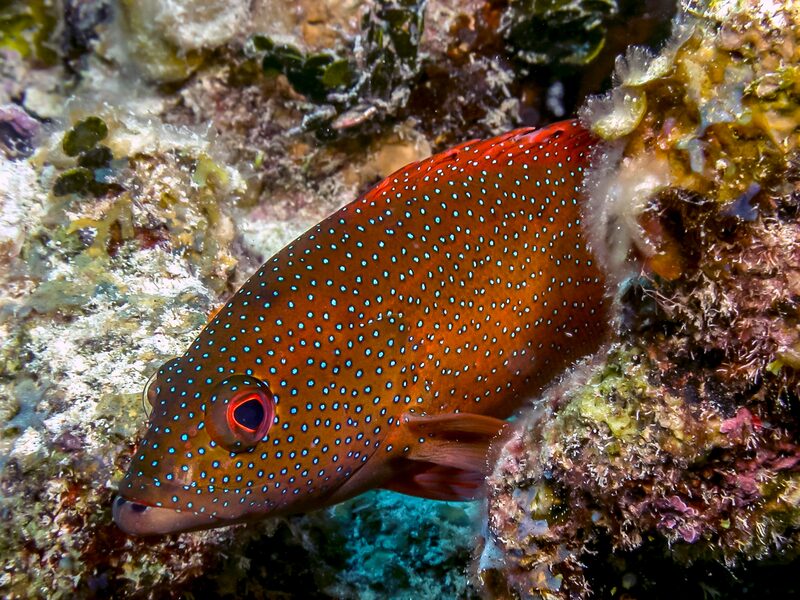
Small grouper typically red with fins to match, covered in small black-edged blue spots, with two prominent black spots on the top of the caudal peduncle and a pair of black blotches on the lower jaw tip; also occurs in bicolor and golden-yellow variations; dorsal fin 9 spines and 14-16 soft rays, anal 3 spines and 9 soft rays.
- Size
- Typically 15-25 cm (6-10 in) per ReefGuide; maximum recorded 44 cm TL (17 in); lives to 11 years.
- Habitat
- Coral reefs in clear water; hides in caves and under ledges by day in shallow West Indian and Bermudan waters, and on deep reefs (at least 45 m) in the Gulf of Mexico; non-migratory.
- Diet
- Mainly small fishes and crustaceans.
- Range
- Caribbean, Bahamas, Florida, Bermuda, Gulf of America and Brazil; western Atlantic from South Carolina and Bermuda to southern Brazil.
Life stages
ReefGuide shows Juvenile and Bicolor Juvenile photos plus a Golden Variation; females mature at about 16 cm and become males at about 20 cm.
Ecological role
Common small reef mesopredator; follows hunting eels as an opportunistic feeding associate.
Explore reef conservation
Learn about Caribbean reef habitats, invasive lionfish and the work of the Caribbean Reef Fish Foundation.
TL means total length; SL excludes the tail fin; FL measures to the tail fork. These measurements are not interchangeable.