
01 / SPECIES PROFILE
Species Overview
Stubby, fusiform sea bass with a pointed snout
- Family
- Serranidae (sea basses)
- IUCN Red List category
- Least Concern
- Size
- Up to 10 cm (4 in); maximum 10 cm TL (4 in).
- Depth range
- 0–26 m; water's edge to at least 18 m.
- Habitat
- Demersal, often in silty water; notes it is not a coral-reef species.
- Diet
- Diet includes zooplankton (small drifting animals), bony fishes and bottom-dwelling crustaceans.
- Geographic range
- Western Atlantic from North Carolina to Florida (rare in the Keys) and Texas, also Mexico and Cuba; adds the Bahamas
- Vulnerability index
- 23.77
- Human hazard
- Harmless
- Reproductive mode
- Both reproductive functions in one individual; External fertilization; Eggs or young are not guarded
- Common name in Spanish
- Serrano aporreado, Serrano leopardo
02 / NATURAL HISTORY
Field notes
Biology and ecology, shown where information is available for this species.
Simultaneous hermaphrodite and pelagic spawner.
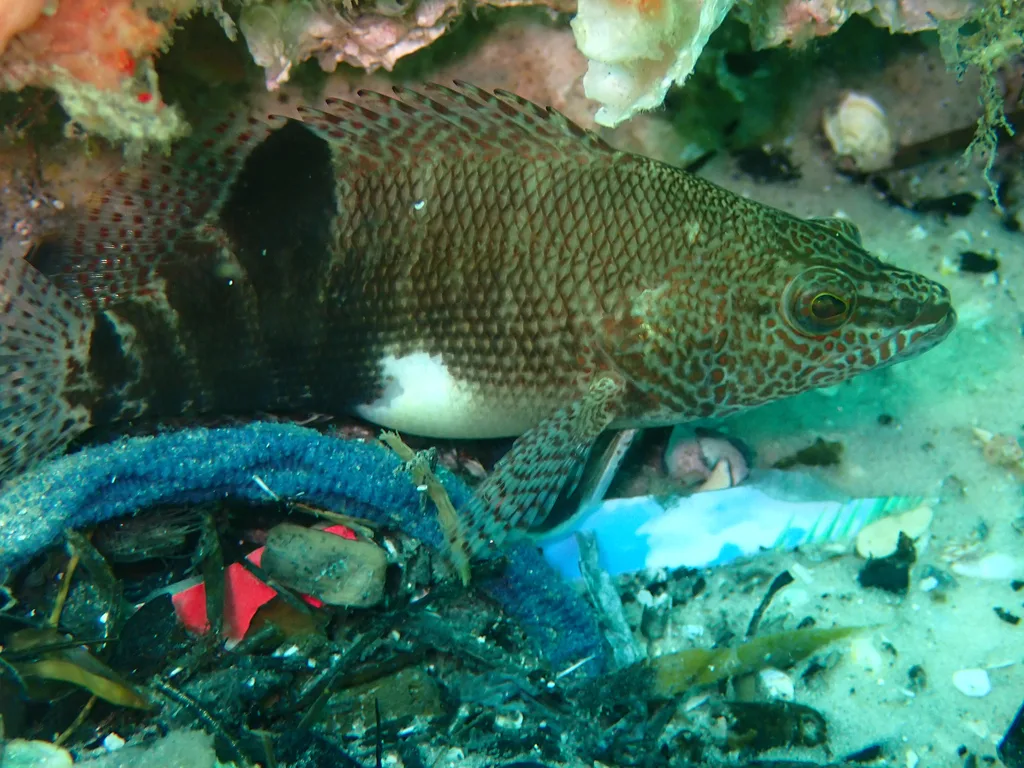
Belted Sandfish (Serranus subligarius) is brown with four dark bars on the rear half, dark scale edges that form lines, and a black blotch on the front soft dorsal fin. Pygmy Sea Bass (Serraniculus pumilio) has a white belly bar, two broad dark bars under the dorsal fin, black pelvic and anal fins, and an abruptly white tail base. Orangeback Bass (Serranus annularis) features two black-ringed orange squares behind the eye and white and orange bars on the lower body. Lantern Bass (Serranus baldwini) has a white belly with four orange-brown rectangular blotches and two rows of black spots on the tail base.
LC – Least Concern
Reported countries and territories (2)
- Cuba
- Mexico
TL means total length; SL excludes the tail fin; FL measures to the tail fork. These measurements are not interchangeable.
CARIBBEAN REEF FISH FOUNDATION
From field knowledge
to reef action.
Explore the Foundation’s current conservation and research work.