
01 / SPECIES PROFILE
Species Overview
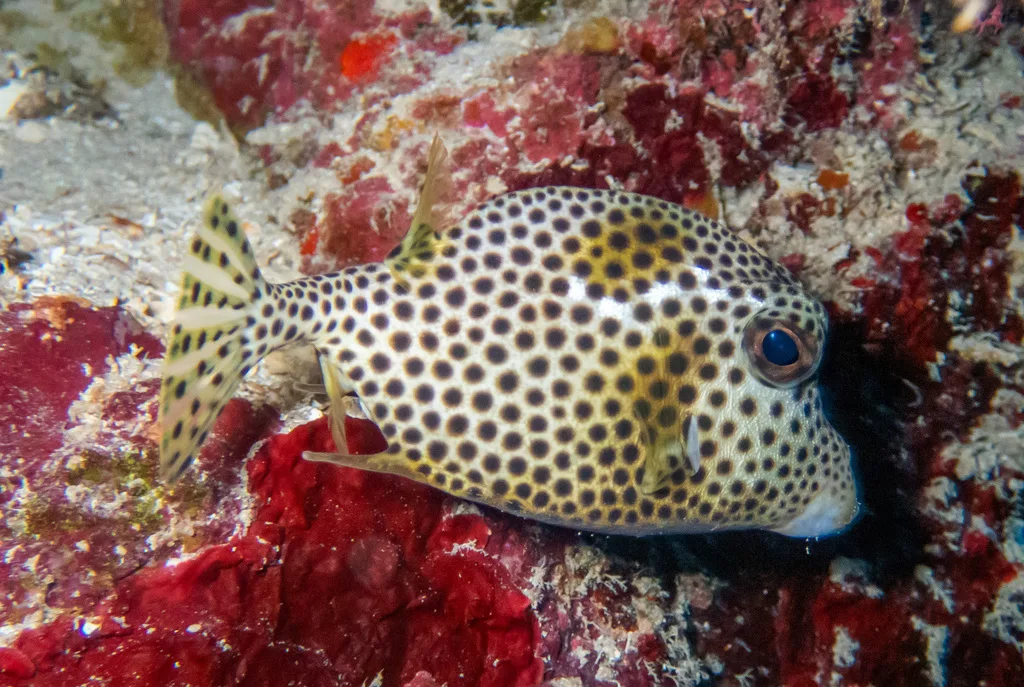
Whitish trunkfish covered with many small black spots on the carapace, tail base and tail fin; white lips; blackish bases to the dorsal, anal and pectoral fins; large adults have three white spots in a diagonal row near the eye
- Family
- Ostraciidae
- IUCN Red List category
- Least Concern
- Size
- Commonly 20 cm TL [7.9 in]; maximum 48 cm TL [18.9 in]. Published accounts give 15-30 cm [6-12 in].
- Depth range
- 5-18 m; 3-50 m.
- Habitat
- Clear water around coral reefs, sometimes under ledges and near small holes.
- Diet
- Small bottom invertebrates including mollusks, crustaceans, crabs, sea stars, brittle stars, sea urchins, sea cucumbers and tunicates, plus seagrasses and algae.
- Geographic range
- Caribbean, Bahamas and Florida; western Atlantic from Florida, the Bahamas and southern Gulf of Mexico to Brazil, also Ascension Island
- Trophic level
- 3.5
- Vulnerability index
- 25.46
- Human hazard
- Reports of ciguatera poisoning
- Reproductive mode
- Separate sexes; External fertilization; Eggs or young are not guarded; Eggs scattered in open water or on the substrate
- Common name in Spanish
- Botella, Chapín de lunares negros, Chapin pintado, Chapín pintado, Cofre, Pez gallina, Torito
- Common name in French
- Coffre zinga
02 / NATURAL HISTORY
Field notes
Biology and ecology, shown where information is available for this species.
the three white spots near the eye appear in large adults.
Benthic invertebrate predator, including of echinoderms; trophic level about 3.2.
Often near ledges and small holes on reefs; releases toxins when excited that can kill other fishes
Smooth Trunkfish (Lactophrys triqueter): dark body with small white spots, the reverse of the Spotted Trunkfish's pale body with black spots (descriptions).
LC – Least Concern; taken in commercial fisheries and the aquarium trade; no specific protections found.
Recorded food groups and items (5)
- Diadema antillarum
- zoobenthos
- echinoderms
- sea urchins
- other benthic invertebrates
Reported countries and territories (37)
- Anguilla
- Antigua and Barbuda
- Aruba
- Bahamas
- Barbados
- Belize
- Bermuda
- British Virgin Islands
- Cayman Islands
- Colombia
- Costa Rica
- Cuba
- Curaçao
- Dominica
- Dominican Republic
- French Guiana
- Grenada
- Guadeloupe
- Guatemala
- Guyana
- Haiti
- Honduras
- Jamaica
- Martinique
- Mexico
- Montserrat
- Nicaragua
- Panama
- Puerto Rico
- Saint Kitts and Nevis
- Saint Lucia
- Saint Vincent and the Grenadines
- Suriname
- Trinidad and Tobago
- Turks and Caicos Islands
- United States Virgin Islands
- Venezuela
TL means total length; SL excludes the tail fin; FL measures to the tail fork. These measurements are not interchangeable.
CARIBBEAN REEF FISH FOUNDATION
From field knowledge
to reef action.
Explore the Foundation’s current conservation and research work.