
01 / SPECIES PROFILE
Species Overview
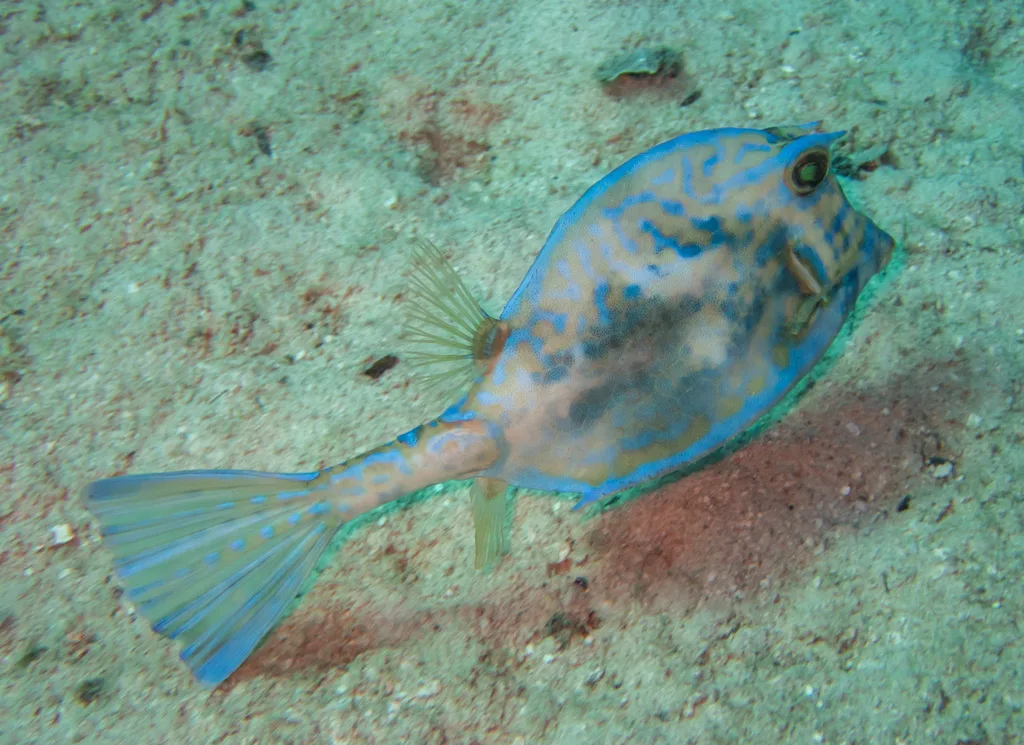
Deep body encased in a carapace of fused hexagonal plates, with a pair of horn-like spines in front of the eyes and another pair at the rear lower corners; grayish-brown to yellowish-green with irregular blue bars, spots and dark blotches, often with 3-4 parallel blue cheek stripes; no pelvic fins or spiny dorsal fin
- Family
- Ostraciidae
- IUCN Red List category
- Least Concern
- Size
- Commonly 20 cm TL [7.9 in]; maximum 55 cm TL [21.7 in]; maturity at about 19-22 cm. Published accounts give 20-38 cm [8-15 in].
- Depth range
- 2-25 m; 1-80 m, usually 10-30 m.
- Habitat
- Mainly seagrass beds; young in mangroves.
- Diet
- Sessile invertebrates such as tunicates, gorgonians and anemones, plus slow-moving crustaceans, sponges, hermit crabs and marine plants.
- Geographic range
- Caribbean, Bahamas, Florida, Gulf of America and Bermuda; western Atlantic from Massachusetts and Bermuda to southeastern Brazil, also reported from the tip of South Africa
- Trophic level
- 3.77
- Vulnerability index
- 31.74
- Human hazard
- Reports of ciguatera poisoning
- Spawning seasonality
- two seasonal peaks per year
- Reproductive mode
- Separate sexes; External fertilization; Eggs or young are not guarded; Eggs scattered in open water or on the substrate
- Common name in Spanish
- Botelia, Chapín, Cofre, Torito azul, Torito común, Torito cornudo
- Common name in French
- Coffre taureau
02 / NATURAL HISTORY
Field notes
Biology and ecology, shown where information is available for this species.
Juveniles occur in mangrove areas
Benthic predator of sessile and slow-moving invertebrates; prey of larger fishes, though its armor may make it undesirable prey.
Spends most of its time in seagrass beds
Oviparous; spawning documented off Venezuela in January-February and June-September; eggs and larvae are pelagic before juveniles settle.
Honeycomb Cowfish (Acanthostracion polygonium): honeycomb plate pattern and an always distinctly rounded tail, versus the Scrawled Cowfish's 2-4 horizontal cheek stripes and round-to-truncate tail.
LC – Least Concern; minor commercial fishery, mainly by traps, and aquarium trade; no specific protections found.
Recorded food groups and items (4)
- zoobenthos
- other benthic invertebrates
- zooplankton
- jellyfish/hydroids
Reported countries and territories (32)
- Anguilla
- Antigua and Barbuda
- Aruba
- Bahamas
- Barbados
- Belize
- Bermuda
- British Virgin Islands
- Colombia
- Costa Rica
- Cuba
- Curaçao
- Dominica
- Dominican Republic
- French Guiana
- Grenada
- Guatemala
- Guyana
- Haiti
- Honduras
- Jamaica
- Mexico
- Nicaragua
- Panama
- Puerto Rico
- Saint Kitts and Nevis
- Saint Lucia
- Saint Vincent and the Grenadines
- Suriname
- Trinidad and Tobago
- United States Virgin Islands
- Venezuela
TL means total length; SL excludes the tail fin; FL measures to the tail fork. These measurements are not interchangeable.
CARIBBEAN REEF FISH FOUNDATION
From field knowledge
to reef action.
Explore the Foundation’s current conservation and research work.