
01 / SPECIES PROFILE
Species Overview
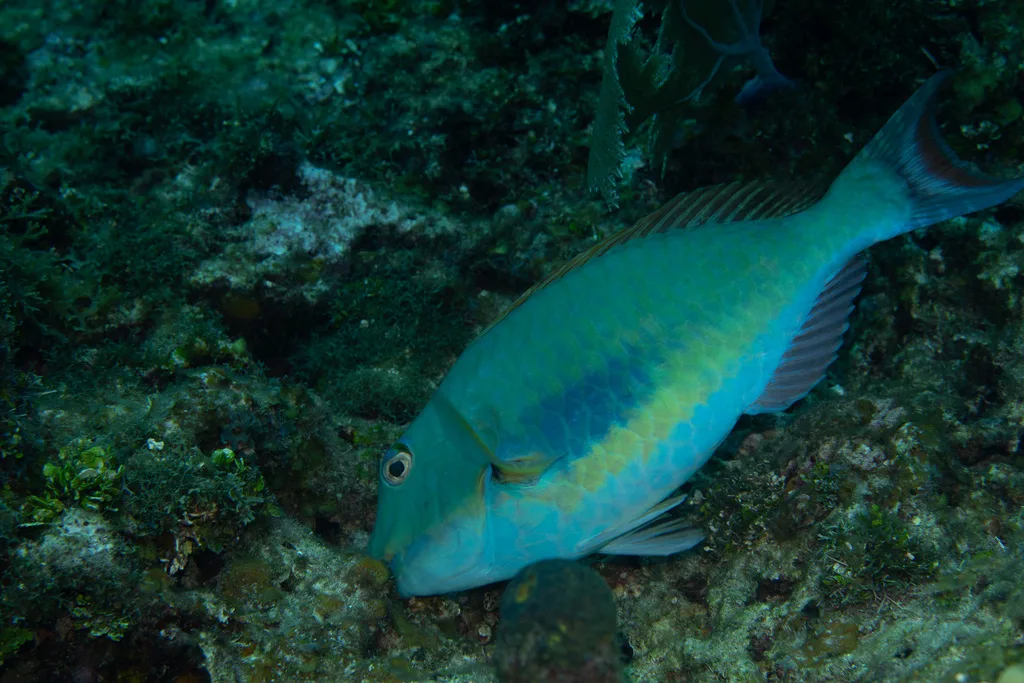
Fusiform parrotfish; dorsal fin IX,10, anal fin III,9. Young adults have a black saddle-shaped mark at the top of the pectoral-fin base, often a faint pale saddle on top of the caudal peduncle, and red or orange dorsal, anal and pelvic fins
- Family
- Labridae (subfamily Scarinae; Published accounts list Scaridae)
- IUCN Red List category
- Least Concern
- Size
- Common 25 cm TL [9.8 in]; maximum 46 cm TL [18 in]. Published accounts give 35–40 cm [14–16 in].
- Depth range
- 1–15 m; Published accounts give 2–12 m.
- Habitat
- Coral reefs and adjacent habitats; young especially in seagrass beds.
- Diet
- Benthic algae and seagrasses.
- Geographic range
- Caribbean, Bahamas, Florida, Bermuda; western Atlantic Caribbean Sea.
- Trophic level
- 2
- Vulnerability index
- 22.7
- Human hazard
- Reports of ciguatera poisoning
- Reproductive mode
- Separate sexes; External fertilization; Eggs or young are not guarded; Eggs scattered in open water or on the substrate
- Common name in Spanish
- Jabón, Lora, Loro, Loro azul, Loro colirrojo, Loro verde, Vieja colorada
- Common name in French
- Perroquet vert
02 / NATURAL HISTORY
Field notes
Biology and ecology, shown where information is available for this species.
Initial phase (with mottled night colors) and Terminal phase (with night colors); juveniles and initial-phase adults can switch to a mottled pattern that matches the bottom.
Herbivorous grazer of algae and seagrass on reefs and seagrass beds.
Juveniles and initial-phase adults camouflage with a mottled pattern; distinct night color patterns shown on.
Protogyny has been proposed, but states overlapping size ranges and similar maturation of males and females strongly suggest separate sexes (gonochorism). Size at maturity not given.
Yellowtail/Redfin Parrotfish (S. rubripinne): has a yellow caudal peduncle and tail in initial phase and, in terminal males, a large black spot on the upper pectoral base with the outer fifth of the pectoral fin abruptly pale; Redtail lacks the yellow tail and shows a pale saddle on the caudal peduncle.
LC – Least Concern; notes minor fishery use.
Recorded food groups and items (4)
- plants
- phytoplankton
- blue-green algae
- diatoms
Reported countries and territories (36)
- Anguilla
- Antigua and Barbuda
- Aruba
- Bahamas
- Barbados
- Belize
- British Virgin Islands
- Cayman Islands
- Colombia
- Costa Rica
- Cuba
- Curaçao
- Dominica
- Dominican Republic
- French Guiana
- Grenada
- Guadeloupe
- Guatemala
- Guyana
- Haiti
- Honduras
- Jamaica
- Martinique
- Mexico
- Montserrat
- Nicaragua
- Panama
- Puerto Rico
- Saint Kitts and Nevis
- Saint Lucia
- Saint Vincent and the Grenadines
- Suriname
- Trinidad and Tobago
- Turks and Caicos Islands
- United States Virgin Islands
- Venezuela
TL means total length; SL excludes the tail fin; FL measures to the tail fork. These measurements are not interchangeable.
CARIBBEAN REEF FISH FOUNDATION
From field knowledge
to reef action.
Explore the Foundation’s current conservation and research work.