
Parrotfishes & Wrasses
Stoplight Parrotfish
Sparisoma viride
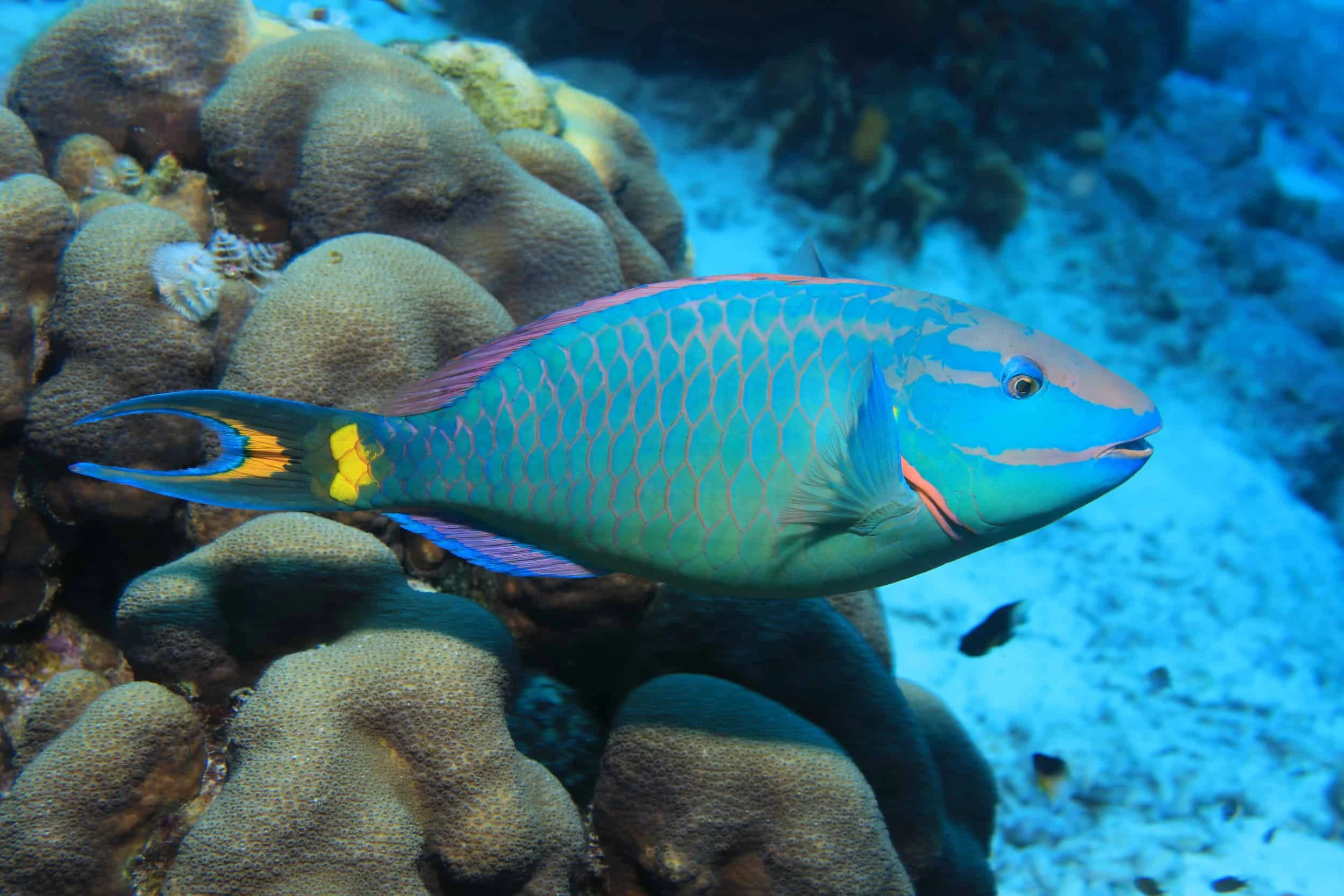
Species Overview
Large parrotfish with plate-like scales and a fused-tooth beak; tail changes from truncate in young to crescent-shaped in large males (Florida Museum). Terminal males are green with three diagonal orange bands on the upper head, a yellow spot at the top of the gill cover, a yellow bar at the tail base and an orange crescent on the tail (FishBase).
- Habitat
- Clear-water coral reefs; young may be found in seagrass beds and other heavily vegetated bottoms (FishBase).
- Diet
- Mainly soft algae, but also observed grazing live coral such as Montastraea annularis (FishBase).
- Range
- Throughout the Caribbean Sea to Brazil, plus southern Florida, Bermuda and the Bahamas (FishBase).
Life stages
Juvenile: dark reddish-brown with three rows of white spots and a white tail bar; Initial phase: brown head, dark-edged pale-centered scales on upper body, bright red belly and fins; Terminal phase (super male): green with orange head bands and yellow spot/bar (FishBase, Florida Museum). All three photographed on ReefGuide.
Ecological role
Major bioeroder whose strong beak produces substantial reef sediment (FishBase); ground coral passes through the gut and is deposited as white sand, with parrotfish possibly producing up to about one ton of sand per acre of reef per year (Florida Museum).
Explore reef conservation
Learn about Caribbean reef habitats, invasive lionfish and the work of the Caribbean Reef Fish Foundation.
TL means total length; SL excludes the tail fin; FL measures to the tail fork. These measurements are not interchangeable.