
01 / SPECIES PROFILE
Species Overview
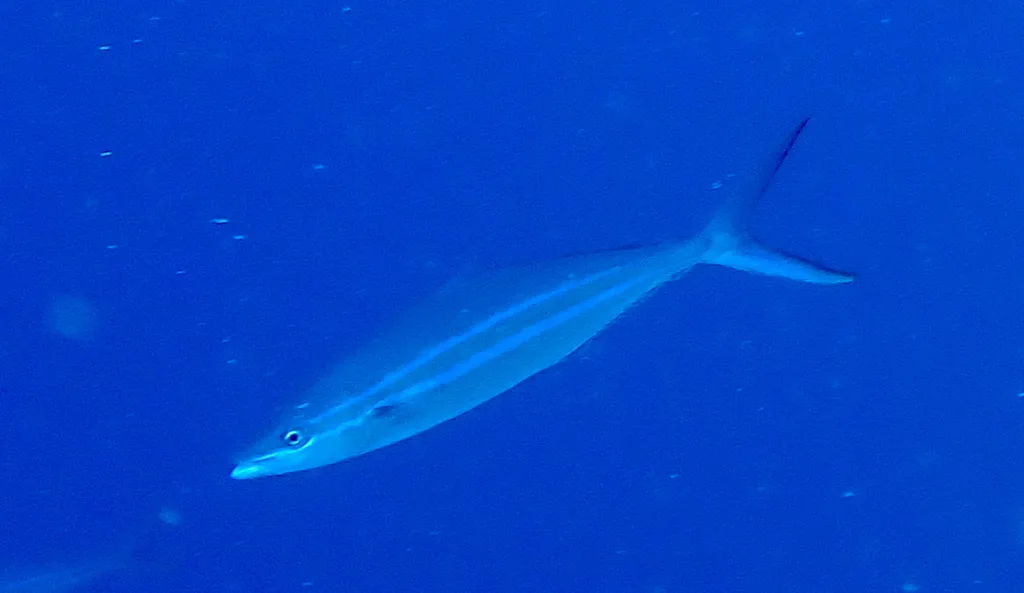
Elongate, streamlined carangid; dark olive-blue or green above, white below, with two narrow light-blue stripes along the side enclosing a broader olive or yellowish stripe; upper jaw ends well before the eye; detached two-rayed finlet behind both dorsal and anal fins
- Family
- Carangidae
- IUCN Red List category
- Least Concern
- Size
- Typically 60-90 cm (24-35 in); common 90 cm TL (35 in); maximum recorded 180 cm TL (71 in).
- Depth range
- 0-150 m, usually 2-10 m; Published accounts give 0-90 m.
- Habitat
- Oceanic and coastal waters, usually near the surface over reefs; sometimes around floating logs and debris far offshore.
- Diet
- Mainly larger zooplankton crustaceans and small fishes.
- Geographic range
- Circumtropical; western Atlantic from Massachusetts and the northern Gulf of Mexico to Rio de Janeiro; eastern Atlantic, Indo-Pacific and eastern Pacific.
- Maximum weight
- 17.05 g
- Wild longevity
- 6 years
- Trophic level
- 3.75
- Vulnerability index
- 50.69
- Human hazard
- Reports of ciguatera poisoning
- Reproductive mode
- Separate sexes; External fertilization; Eggs or young are not guarded; Eggs scattered in open water or on the substrate
- Common name in Spanish
- Cola amarilla, Corredores, Llorotel, Macaela, Macarela, Macarela arco iris, Macarela salmón, Peje rata, Pejerata, Pez rata, Picudo rayado, Remoremo, Salmon, Salmón, Salmón cubano, Salmonete, Sardinata, Tabio, Zapatero ligereto
- Common name in French
- Carangue arc-en-ciel, Comète saumon, Coureur arc-en-ciel, Dauphin, Dauphin vert, Galati, Saumon, Sorcier
02 / NATURAL HISTORY
Field notes
Biology and ecology, shown where information is available for this species.
Fast pelagic predator of zooplankton and small fishes that visits reef edges.
May form large schools; associates with floating objects
Eggs pelagic
Almaco jack (Seriola rivoliana): deeper body with a dark band from nape through eye and no detached finlets; the rainbow runner's detached finlets and blue-olive-blue side stripes are diagnostic.
LC – Least Concern; valued food and gamefish.
Recorded food groups and items (32)
- nekton
- cephalopods
- squids/cuttlefish
- finfish
- bony fish
- unspecifed fishes
- Halobates spp.
- zoobenthos
- insects
- benthic crust.
- amphipods
- benthic copepods
- crabs
- Crustacea
- shrimps/prawns
- stomatopods
- mollusks
- gastropods
- other benthic invertebrates
- sponges/tunicates
- ascidians
- worms
- non-annelids
- polychaetes
- zooplankton
- fish (early stages)
- fish eggs/larvae
- jellyfish/hydroids
- other planktonic invertebrates
- Euphausiidae
- planktonic crust.
- euphausiids
Reported countries and territories (36)
- Anguilla
- Antigua and Barbuda
- Aruba
- Bahamas
- Barbados
- Belize
- British Virgin Islands
- Cayman Islands
- Colombia
- Costa Rica
- Cuba
- Curaçao
- Dominica
- Dominican Republic
- French Guiana
- Grenada
- Guadeloupe
- Guatemala
- Guyana
- Haiti
- Honduras
- Jamaica
- Martinique
- Mexico
- Montserrat
- Nicaragua
- Panama
- Puerto Rico
- Saint Kitts and Nevis
- Saint Lucia
- Saint Vincent and the Grenadines
- Suriname
- Trinidad and Tobago
- Turks and Caicos Islands
- United States Virgin Islands
- Venezuela
TL means total length; SL excludes the tail fin; FL measures to the tail fork. These measurements are not interchangeable.
CARIBBEAN REEF FISH FOUNDATION
From field knowledge
to reef action.
Explore the Foundation’s current conservation and research work.