
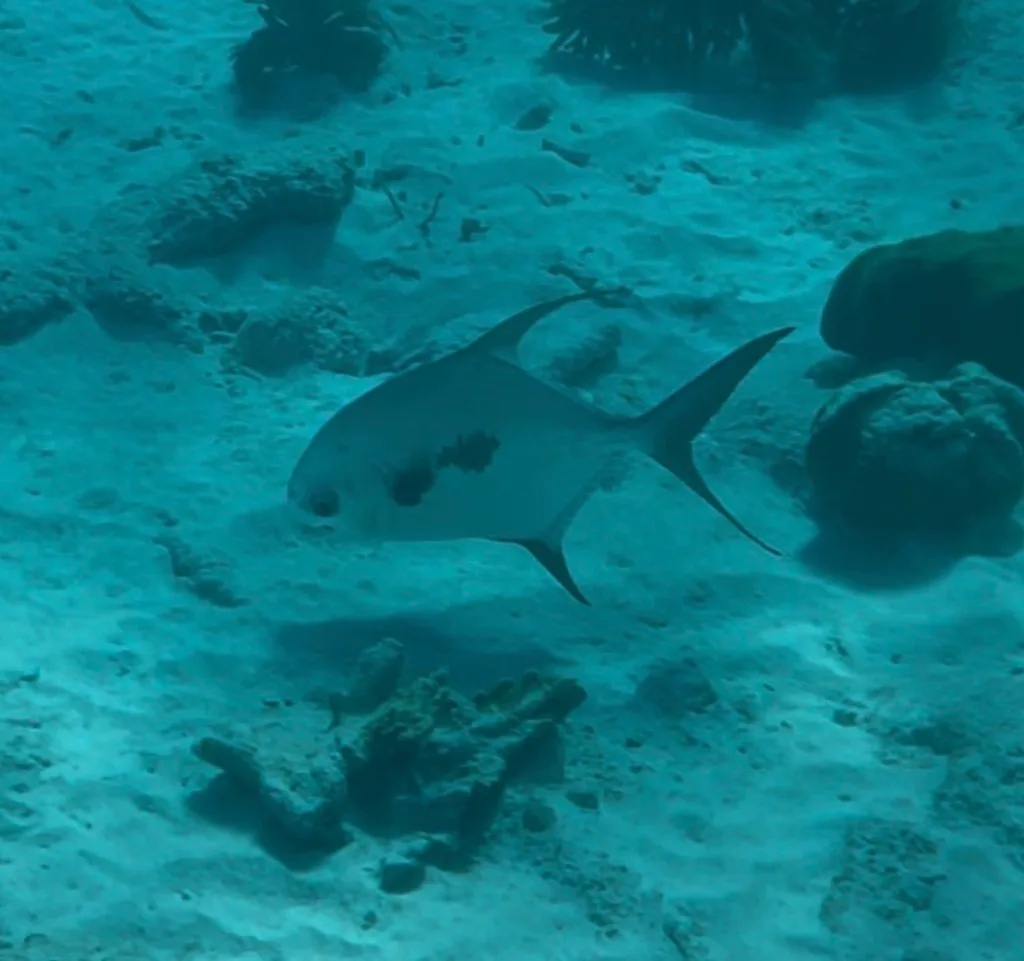
01 / SPECIES PROFILE
Species Overview
Short, deep-bodied pompano without scutes; very long dark anterior lobes on dorsal and anal fins; blackish pectoral fins; broad orange-yellow patch on the belly ahead of the anal fin; dorsal VI-VII spines, 18-21 soft rays; anal II-III, 16-18 soft rays
- Family
- Carangidae
- IUCN Red List category
- Least Concern
- Size
- Typically 30-90 cm (12-35 in); common 94 cm FL (37 in); maximum recorded 122 cm FL (48 in), 36 kg; maturity at about 55 cm.
- Depth range
- 0-36 m, usually 0-30 m; Published accounts give 0-30 m.
- Habitat
- Channels and holes, sandy flats, around reefs and sometimes over mud; smaller fish tolerate brackish water; juveniles in the surf zone.
- Diet
- Adults eat mollusks, crabs, shrimp and small fishes; juveniles eat benthic invertebrates.
- Geographic range
- Caribbean, Bahamas, Florida, Bermuda, Gulf of America, Brazil; western Atlantic from Massachusetts to southeastern Brazil incl. the Bahamas and West Indies; African reports mostly misidentified T. teraia.
- Maximum weight
- 36 kg
- Wild longevity
- 23 years
- Trophic level
- 3.5
- Vulnerability index
- 42.4
- Human hazard
- Harmless
- Reproductive mode
- Separate sexes; External fertilization; Eggs or young are not guarded; Eggs scattered in open water or on the substrate
- Common name in Spanish
- Palometa, Pampanillo, Pampanito, Pampano, Pámpano, Pámpano de bandera, Pampano erizero, Pampano palometa, Pámpano palometa
- Common name in French
- Carangue à plumes, Carangue plume, Pompaneau plume
02 / NATURAL HISTORY
Field notes
Biology and ecology, shown where information is available for this species.
notes juveniles school in large numbers in the surf zone of sandy beaches in summer.
Bottom-feeding predator of mollusks and crustaceans over sand flats and reefs.
Usually solitary or in small schools as adults; juveniles in large schools
Adults spawn offshore; maturity at about 55 cm.
Palometa (Trachinotus goodei): also has long dark fin lobes but is smaller (to 50 cm TL) with four narrow dark bars on the upper sides, which permit lacks; permit has an orange-yellow belly patch.
LC – Least Concern; highly esteemed light-tackle gamefish with commercial fisheries and aquaculture.
Recorded food groups and items (11)
- zoobenthos
- benthic crust.
- amphipods
- crabs
- shrimps/prawns
- Diadema antillarum
- echinoderms
- sea urchins
- Aliger gigas
- mollusks
- gastropods
Reported countries and territories (37)
- Anguilla
- Antigua and Barbuda
- Aruba
- Bahamas
- Barbados
- Belize
- Bermuda
- Bonaire, Sint Eustatius and Saba
- British Virgin Islands
- Cayman Islands
- Colombia
- Costa Rica
- Cuba
- Curaçao
- Dominica
- Dominican Republic
- French Guiana
- Grenada
- Guadeloupe
- Guatemala
- Guyana
- Haiti
- Honduras
- Jamaica
- Martinique
- Mexico
- Montserrat
- Nicaragua
- Panama
- Puerto Rico
- Saint Kitts and Nevis
- Saint Lucia
- Saint Vincent and the Grenadines
- Suriname
- Trinidad and Tobago
- United States Virgin Islands
- Venezuela
TL means total length; SL excludes the tail fin; FL measures to the tail fork. These measurements are not interchangeable.
CARIBBEAN REEF FISH FOUNDATION
From field knowledge
to reef action.
Explore the Foundation’s current conservation and research work.