

01 / SPECIES PROFILE
Species Overview
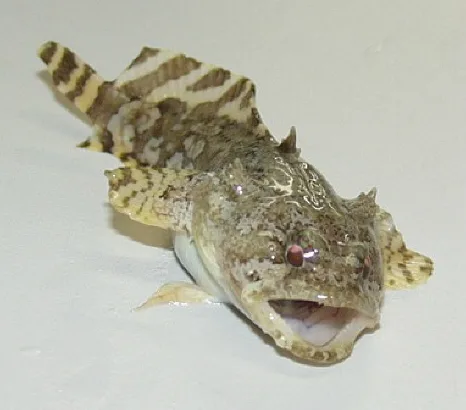
Features dark brown bars on the caudal and pectoral fins, with the pectoral bars appearing irregularly joined
- Family
- Batrachoididae
- Size
- Maximum recorded 33 cm TL.
- Depth range
- 0–5 m
- Habitat
- Marine; demersal.
- Diet
- Diet includes echinoderms, attached crustaceans, bony fishes, insects, bottom-dwelling crustaceans, bottom-dwelling mollusks and bottom-dwelling worms.
- Geographic range
- Western Atlantic: Florida (USA), Little Bahama Bank (Bahamas) and the entire Gulf of Mexico to Campeche, Mexico. Range extended to Brazil.
- Vulnerability index
- 38.21
- Human hazard
- Reports of ciguatera poisoning
- Reproductive mode
- Separate sexes; External fertilization; Polygyny; Egg or nest guarding; Nesting
- Common name in Spanish
- Sapo boquiblanca, Sapo de boca blanca
02 / NATURAL HISTORY
Field notes
Biology and ecology, shown where information is available for this species.
Commonly found in seagrass beds and rocky cuts in coastal bays and lagoons, and in shallows along open coast. In western coast of Florida, adults spawn in February and March. Nesting males produce grunt calls called the boatwhistle as advertisement of competition among males and to attract females. Neither opercular nor dorsal gland is venomous.
O. tau has complete pale bars across pectoral and caudal fins. O. pardus has irregular and incomplete bars acrossfins.
LC – Least Concern.
Reported countries and territories (5)
- Bahamas
- Belize
- Cuba
- Honduras
- Mexico
TL means total length; SL excludes the tail fin; FL measures to the tail fork. These measurements are not interchangeable.
CARIBBEAN REEF FISH FOUNDATION
From field knowledge
to reef action.
Explore the Foundation’s current conservation and research work.