
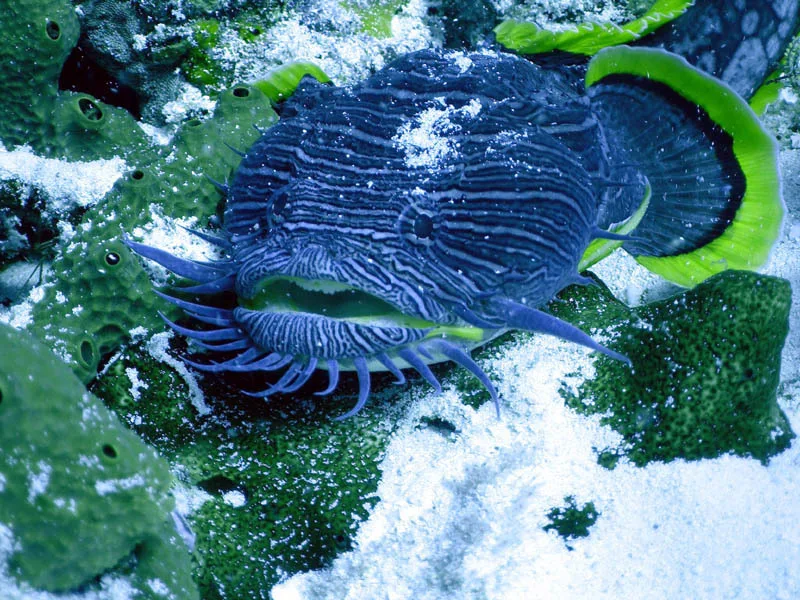
01 / SPECIES PROFILE
Species Overview
Pelvic fins entirely yellow; dorsal, caudal, anal and pectoral fins edged in yellow
- Family
- Batrachoididae
- IUCN Red List category
- Endangered
- Size
- 10–15 cm (4–6 in); maximum recorded 24 cm TL (9.4 in).
- Depth range
- 8–18 m; 8–25 m, usually 10–15 m.
- Habitat
- Marine, reef-associated and non-migratory; mostly in or near rocky caves.
- Diet
- Small fishes, snails and polychaete.
- Geographic range
- Caribbean: Cozumel, Mexico; Published accounts give Cozumel Island and Belize. Wider: none.
- Trophic level
- 3.62
- Vulnerability index
- 32.26
- Human hazard
- Harmless
- Reproductive mode
- Separate sexes; External fertilization; Egg or nest guarding
- Common name in Spanish
- Sapo magnifico
02 / NATURAL HISTORY
Field notes
Biology and ecology, shown where information is available for this species.
Cave-dwelling reef predator; trophic level 3.6.
Shelters in or near rocky caves
Splendid Toadfish: black and white zebra head lines, grey-mesh body, and wide orange/yellow fin edges. Starry Toadfish: black and white dots, central-only branched chin barbels. Whitelined Toadfish: black with white head lines, central-only branched chin barbels.
EN – Endangered; Published accounts list criteria B2ab(iii), indicating a very small area of occupancy with declining habitat quality. No specific protections found.
Recorded food groups and items (8)
- nekton
- finfish
- bony fish
- zoobenthos
- mollusks
- gastropods
- worms
- polychaetes
Reported countries and territories (2)
- Belize
- Mexico
TL means total length; SL excludes the tail fin; FL measures to the tail fork. These measurements are not interchangeable.
CARIBBEAN REEF FISH FOUNDATION
From field knowledge
to reef action.
Explore the Foundation’s current conservation and research work.