
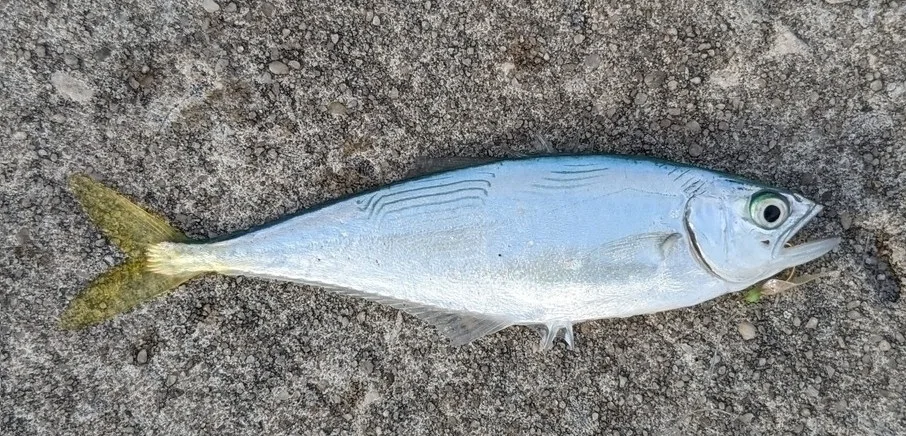

01 / SPECIES PROFILE
Species Overview
Long, very flat jack with a blue-green back, silvery to white sides, sometimes golden highlights, and small needle-like scales buried in the skin; a row of separate finlets behind the dorsal and anal fins
- Family
- Carangidae
- Size
- Maximum recorded 35 cm TL (14 in); commonly 27 cm TL (11 in); heaviest published weight 287.00 g.
- Depth range
- 0-50 m.
- Habitat
- Inshore along sandy beaches, bays and inlets; enters estuaries, mangroves and even fresh water, preferring murky water.
- Diet
- Fishes and crustaceans.
- Geographic range
- Western Atlantic from Maine and the Gulf of Mexico to Uruguay, including most of the West Indies but not the Bahamas; also eastern Pacific.
- Maximum weight
- 287 g
- Trophic level
- 3.53
- Vulnerability index
- 25.6
- Human hazard
- Venomous
- Reproductive mode
- Separate sexes; External fertilization; Eggs or young are not guarded; Eggs scattered in open water or on the substrate
- Common name in Spanish
- Cacana, Carpin, Caspin, Chaqueta de cuero, Cuchillo, Cueriduro, Huelva, Longino, Macarela, Meona, Monda, Palometa, Perrito, Perritos, Perritp, Piña sietecueros, Quiebra-hacha, Sierrita, Siete cuero, Siete cueros, Voladora, Voladora mascapalo, Zapatero, Zapatero de mar, Zapatero ligerito, Zapatero siete cueros, Zapatero sietecueros
- Common name in French
- Carangue plate, Sauteur, Sauteur cuir
02 / NATURAL HISTORY
Field notes
Biology and ecology, shown where information is available for this species.
Coastal predator of small fishes.
Large, fast schools that often leap out of the water; young sometimes float head-down at the surface.
Other jacks: the leatherjacket's flat body, buried scales and separate finlets set it apart.
LC – Least Concern; spines can cause painful wounds.
Recorded food groups and items (20)
- detritus
- debris
- Anchovies
- nekton
- finfish
- bony fish
- Diapterus auratus
- Bairdiella chrysoura
- fish skin
- plants
- phytoplankton
- zoobenthos
- benthic crust.
- shrimps/prawns
- other benthic invertebrates
- zooplankton
- other planktonic invertebrates
- planktonic crust.
- mysids
- planktonic copepods
Reported countries and territories (35)
- Anguilla
- Antigua and Barbuda
- Aruba
- Barbados
- Belize
- British Virgin Islands
- Cayman Islands
- Colombia
- Costa Rica
- Cuba
- Curaçao
- Dominica
- Dominican Republic
- French Guiana
- Grenada
- Guadeloupe
- Guatemala
- Guyana
- Haiti
- Honduras
- Jamaica
- Martinique
- Mexico
- Montserrat
- Nicaragua
- Panama
- Puerto Rico
- Saint Kitts and Nevis
- Saint Lucia
- Saint Vincent and the Grenadines
- Suriname
- Trinidad and Tobago
- Turks and Caicos Islands
- United States Virgin Islands
- Venezuela
TL means total length; SL excludes the tail fin; FL measures to the tail fork. These measurements are not interchangeable.
CARIBBEAN REEF FISH FOUNDATION
From field knowledge
to reef action.
Explore the Foundation’s current conservation and research work.