

01 / SPECIES PROFILE
Species Overview
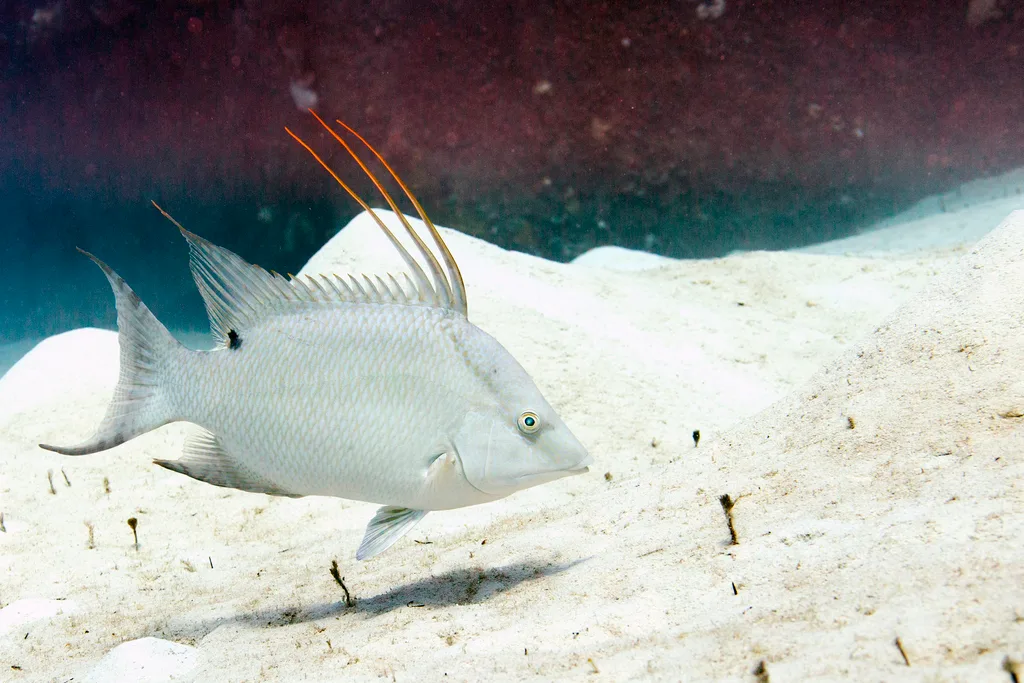
Deep, laterally compressed wrasse with a strongly arched back and long pig-like snout; first three dorsal spines elongate and filamentous; red iris; mottled brownish-red colour with a black spot at the rear base of the dorsal fin; males more intensely coloured, dark from snout to forehead; dorsal 14 spines/11 soft rays
- Family
- Labridae
- IUCN Red List category
- Vulnerable
- Size
- Common 35 cm TL (14 in); max recorded 91 cm TL (36 in), 11 kg, age 23 years; 30–60 cm (1–2 ft).
- Depth range
- 3–30 m.
- Habitat
- Open bottoms and coral reefs, often where gorgonians are abundant; larger fish on main reefs, smaller on patch reefs; juveniles in seagrass beds.
- Diet
- Mainly mollusks, also hermit crabs, other crabs, amphipods and sea urchins; roots through sand with its snout and crushes shells with pharyngeal jaws.
- Geographic range
- Caribbean, Bahamas, Florida, Gulf and Bermuda; wider range Nova Scotia and Bermuda to northern South America
- Maximum weight
- 11 kg
- Wild longevity
- 23 years
- Vulnerability index
- 58.79
- Human hazard
- Reports of ciguatera poisoning
- Spawning seasonality
- one clear seasonal peak per year
- Reproductive mode
- Female-to-male sex change (protogyny); External fertilization; Polygyny; Eggs or young are not guarded; Eggs scattered in open water or on the substrate
- Common name in Spanish
- Boquinete, Capitán, Doncella de pluma, Jaqueton blanco, Pargo gallo, Pargo pluma, Pez perro
- Common name in French
- Labre capitaine
02 / NATURAL HISTORY
Field notes
Biology and ecology, shown where information is available for this species.
shows Juvenile, Initial Phase and Terminal Phase; juveniles are reddish with faint vertical bands and often live in seagrass.
Large bottom-feeding predator of mollusks and other hard-shelled invertebrates; prey of larger bony fishes and sharks.
Diurnal forager; lives in small harem groups where a dominant male guards several females
Monandric protogynous hermaphrodite; females change to males through social dominance, often around 3 years and ~35 cm; harem spawner with a ritual spawning rush; off south Florida peak spawning Feb–Mar in late afternoon/evening; eggs hatch in ~24 h.
Spanish and spotfin hogfish (Bodianus spp.) share the name but are fusiform, lack the long trailing first three dorsal spines and have bold colour blocks rather than mottled brown-red.
VU – Vulnerable; fishing pressure has reduced some local populations and east Florida commercial catch rates have declined; captive breeding has succeeded
Recorded food groups and items (7)
- Echinometra viridis
- zoobenthos
- echinoderms
- sea urchins
- Aliger gigas
- mollusks
- gastropods
Reported countries and territories (37)
- Anguilla
- Antigua and Barbuda
- Aruba
- Bahamas
- Barbados
- Belize
- Bermuda
- British Virgin Islands
- Cayman Islands
- Colombia
- Costa Rica
- Cuba
- Curaçao
- Dominica
- Dominican Republic
- French Guiana
- Grenada
- Guadeloupe
- Guatemala
- Guyana
- Haiti
- Honduras
- Jamaica
- Martinique
- Mexico
- Montserrat
- Nicaragua
- Panama
- Puerto Rico
- Saint Kitts and Nevis
- Saint Lucia
- Saint Vincent and the Grenadines
- Suriname
- Trinidad and Tobago
- Turks and Caicos Islands
- United States Virgin Islands
- Venezuela
TL means total length; SL excludes the tail fin; FL measures to the tail fork. These measurements are not interchangeable.
CARIBBEAN REEF FISH FOUNDATION
From field knowledge
to reef action.
Explore the Foundation’s current conservation and research work.