
01 / SPECIES PROFILE
Species Overview
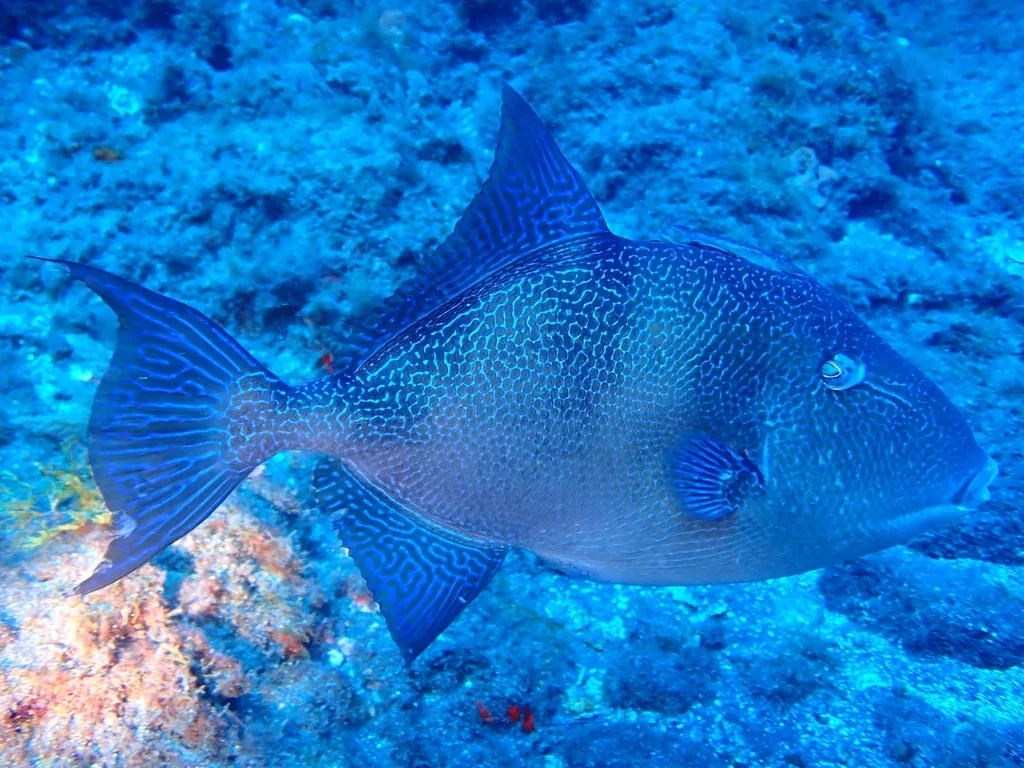
Tall, laterally compressed body with leathery, plate-like scales and a small mouth with eight incisor-like teeth; first dorsal fin of 3 spines (first locks, second is the 'trigger'). Adults olive-gray to yellowish-brown with blue spots and lines on upper body and fins, blue upper eye rim, three faint dark bars and a pale chin band
- Family
- Balistidae
- Size
- Typical adult 12–22 cm (5–9 in), common length 44 cm TL (17 in); maximum recorded 66.0 cm TL (26 in) and 6.2 kg.
- Depth range
- 5–15 m typical diver sightings; 0–100 m, usually 0–55 m; Published accounts give adults at about 24–91 m.
- Habitat
- Bays, harbors, lagoons and seaward reefs; adults on hard bottoms, ledges and artificial reefs; juveniles drift at the surface in Sargassum.
- Diet
- Benthic hard-shelled invertebrates including crabs, shrimp, sea urchins, sand dollars, sea stars and bivalves, uncovering buried sand dollars with water jets; juveniles eat algae, hydroids, barnacles and polychaetes.
- Geographic range
- Caribbean: Bahamas and Caribbean; wider range western Atlantic from Nova Scotia to Argentina including Bermuda and the Gulf of America, and eastern Atlantic
- Maximum weight
- 6.2 kg
- Wild longevity
- 15 years
- Trophic level
- 3.45
- Vulnerability index
- 46.03
- Human hazard
- Reports of ciguatera poisoning
- Spawning seasonality
- one clear seasonal peak per year
- Reproductive mode
- Separate sexes; External fertilization; Monogamy; Egg or nest guarding; Nesting
- Common name in Spanish
- Ballesta, Bot, Cachua, Cachúa, Cocuyo, Cochino gris, Escopeta, Lija moteada, Peje puerco, Pejepuerco, Pejepuerco blanco, Penolera, Pez ballesta, Puerco, Roncon, Sabaco, Sobaco, Tapa fallas, Varraco
- Common name in French
- Baliste cabri, Baliste capri, Baliste commun, Baliste commune, Baliste de Caroline, Baliste gris, Baliste, Cochon de mer, Fanfré, Poisson à gâchette, Poisson-gâchette, Poisson-porc
02 / NATURAL HISTORY
Field notes
Biology and ecology, shown where information is available for this species.
Juveniles yellowish with small violet dots and dark patches, drifting among Sargassum for 4–7 months before settling on reefs at about 13–18 cm; spawning males turn dark charcoal and nesting females show a white-and-black pattern.
Predator of benthic invertebrates (trophic level 4.1,); prey of amberjack, grouper and sharks as adults, and of tuna, dolphinfish, billfish and sharks as juveniles.
Solitary or in small groups; diurnal predator; when threatened wedges into a crevice and locks its first dorsal spine upright; adults guard nests.
Oviparous; males build sand nests and spawn with multiple females (polygamous), and adults guard eggs that hatch in about 1–2 days; spawning roughly April–September; mature at about 2 years.
Queen Triggerfish (B. vetula): has two curved bright blue bands from snout to pectoral fin and long tail filaments, which Gray Triggerfish lacks.
VU – Vulnerable; important commercial and recreational fishery; managed by the Gulf and South Atlantic Fishery Management Councils with size and bag limits, catch limits and spawning closures, and in the U.S. Caribbean by the Caribbean Fishery Management Council within a Puerto Rico triggerfish complex.
Recorded food groups and items (13)
- zoobenthos
- benthic crust.
- Arbacia punctulata
- echinoderms
- Clypeaster subdepressus
- Encope michelini
- Encope michelini
- Leodia sexiesperforata
- Mellita tenuis
- Arbacia punctulata
- sea urchins
- mollusks
- other benthic invertebrates
Reported countries and territories (29)
- Antigua and Barbuda
- Aruba
- Bahamas
- Barbados
- Belize
- Bermuda
- Colombia
- Costa Rica
- Cuba
- Curaçao
- Dominica
- Dominican Republic
- French Guiana
- Grenada
- Guatemala
- Guyana
- Haiti
- Honduras
- Jamaica
- Mexico
- Nicaragua
- Panama
- Puerto Rico
- Saint Kitts and Nevis
- Saint Lucia
- Saint Vincent and the Grenadines
- Suriname
- Trinidad and Tobago
- Venezuela
TL means total length; SL excludes the tail fin; FL measures to the tail fork. These measurements are not interchangeable.
CARIBBEAN REEF FISH FOUNDATION
From field knowledge
to reef action.
Explore the Foundation’s current conservation and research work.