
Triggerfishes
Queen Triggerfish
Balistes vetula
Species Overview
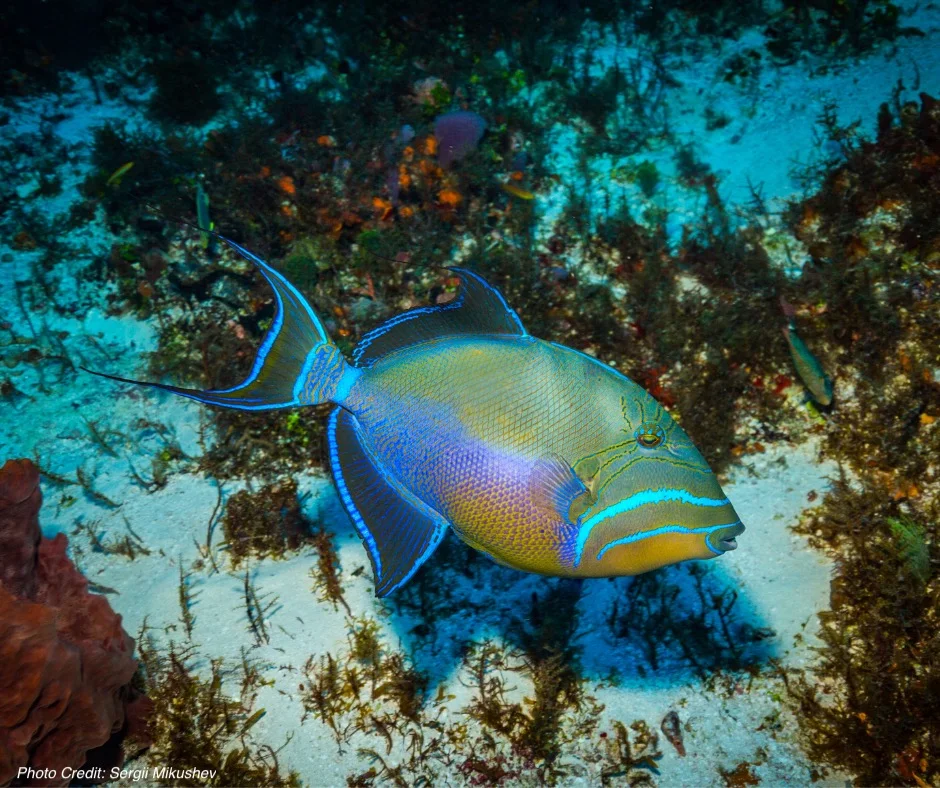
Large oval, compressed triggerfish with greenish- or bluish-gray back and orange-yellow lower head and belly; two broad curved bright blue bands from snout toward the pectoral fins, a blue ring around the lips, a blue bar across the tail base and blue bands in the median fins; crescent tail with long filaments; 3 dorsal spines (FishBase; Florida Museum).
- Size
- Typical adult 20–40 cm (8–16 in) (ReefGuide), common length 30 cm TL (12 in) (FishBase); maximum recorded 60.0 cm TL (23.6 in) and 5.4 kg (FishBase).
- Habitat
- Rocky and coral reef areas; may also occur over sand and seagrass (FishBase; Florida Museum).
- Diet
- Mainly benthic invertebrates; flips sea urchins with water jets to attack the short-spined underside, and also eats bivalves, crabs, sea stars, sea cucumbers, shrimp, polychaetes and macroalgae (FishBase; Florida Museum).
- Range
- Caribbean: widespread in the Caribbean and Bahamas (ReefGuide); wider range western and eastern Atlantic including Florida, Bermuda and the Gulf of America (FishBase; ReefGuide); USVI:.
Life stages
Juveniles have shorter fins and paler color; sexes look alike (Florida Museum). No life-stage photos on ReefGuide.
Ecological role
Important predator of sea urchins and other benthic invertebrates (FishBase; Florida Museum); prey of groupers, jacks, sharks, tuna and marlin (Florida Museum).
Explore reef conservation
Learn about Caribbean reef habitats, invasive lionfish and the work of the Caribbean Reef Fish Foundation.
TL means total length; SL excludes the tail fin; FL measures to the tail fork. These measurements are not interchangeable.