
Parrotfishes & Wrasses
Bluehead Wrasse
Thalassoma bifasciatum
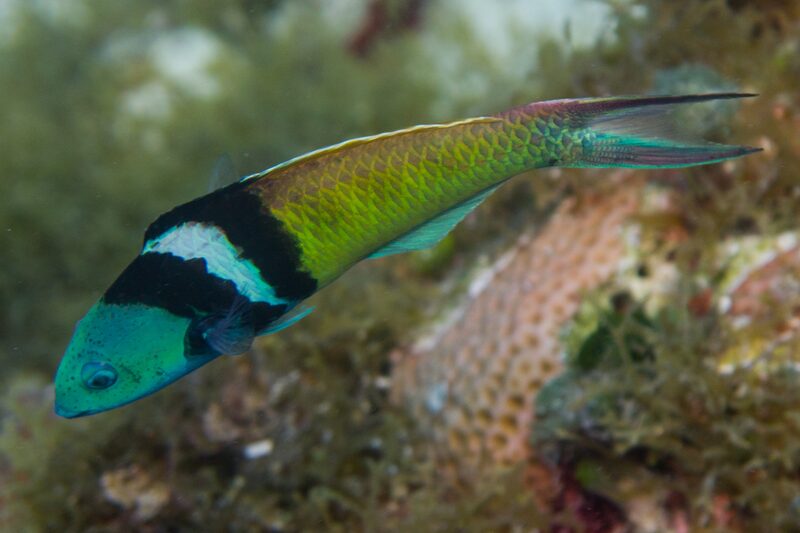
Species Overview
Elongate, compressed wrasse with a blunt snout that swims mainly with its pectoral fins; dorsal fin VIII/12–13, anal fin III/10–11 (FishBase, Florida Museum).
- Size
- Typical adult 10–15 cm (4–6 in) (ReefGuide); maximum recorded 25 cm TL (9.8 in) (FishBase); can mature at 3.8 cm (Florida Museum).
- Habitat
- Reefs, inshore bays and seagrass beds; also rocky flats and sand where water is clear; most abundant on shallow reefs (FishBase, Florida Museum).
- Diet
- Zooplankton and small bottom animals, plus ectoparasites of other fishes; also eats eggs of saddle blenny, beaugregory and sergeant major (FishBase, Florida Museum).
- Range
- Caribbean, Bahamas, Bermuda, South Florida (ReefGuide); western Atlantic incl. Bermuda, Florida, southeastern Gulf of Mexico, Caribbean and northern South America (FishBase).
Life stages
Juvenile/initial: black mid-side stripe (often broken into blotches) with yellow back on reefs or whitish back inshore, may be male or female; terminal (supermale): bright blue head, two black vertical bars separated by a pale bar, green body and lunate tail, always male, about 4% of population (FishBase, Florida Museum); ReefGuide shows Initial, Intermediate and Terminal phases.
Ecological role
Major cleaner fish removing parasites and dead tissue from other reef fishes; prey of trumpetfish, red hind, greater soapfish and yellowfin grouper (Florida Museum).
Explore reef conservation
Learn about Caribbean reef habitats, invasive lionfish and the work of the Caribbean Reef Fish Foundation.
TL means total length; SL excludes the tail fin; FL measures to the tail fork. These measurements are not interchangeable.