
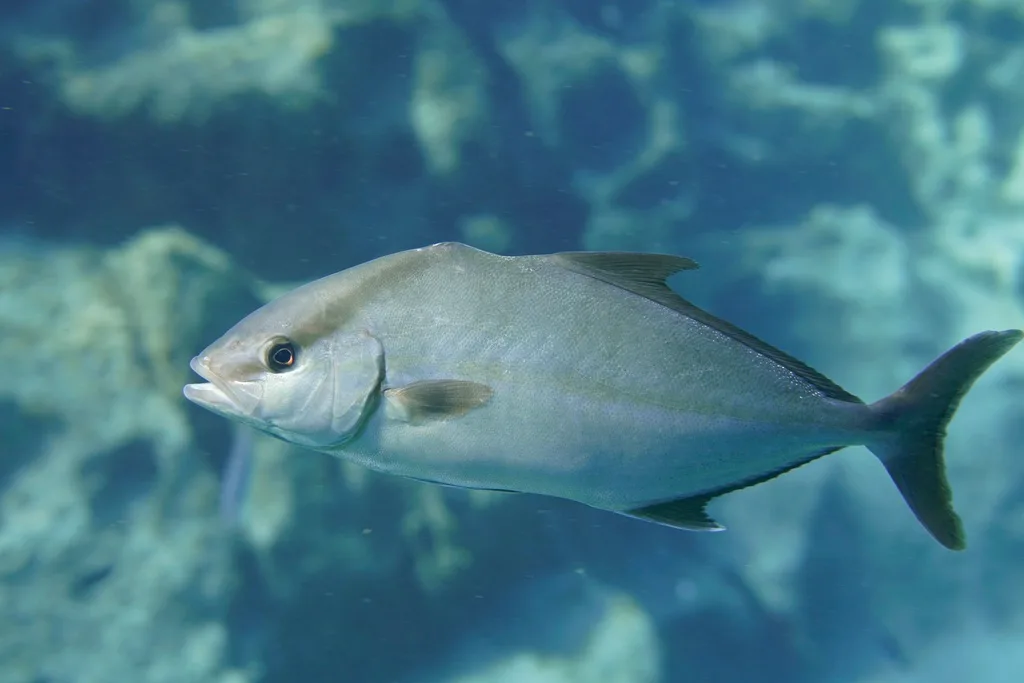
01 / SPECIES PROFILE
Species Overview
Deep-bodied amberjack; brown or blue-green to olive above with a yellow midlateral stripe and a dark yellowish-brown band from the nape through the eye; tall second-dorsal lobe 1.3-1.6 times the pectoral length; upper jaw very broad at rear; dorsal VIII spines, 27-33 soft rays; anal III, 18-22 soft rays
- Family
- Carangidae
- IUCN Red List category
- Least Concern
- Size
- Typically 30-60 cm (12-24 in); common 90 cm TL (35 in); maximum recorded 160 cm FL (63 in), 59.9 kg.
- Depth range
- 5-245 m, usually 30-35 m; Published accounts give 15-55 m.
- Habitat
- Adults benthopelagic on outer reef slopes and offshore banks; young around floating objects.
- Diet
- Mainly fishes, with some invertebrates.
- Geographic range
- Circumtropical; circumglobal, with western Atlantic range Cape Cod to northern Argentina; eastern Atlantic range poorly established.
- Maximum weight
- 59.9 kg
- Trophic level
- 4.5
- Vulnerability index
- 73.55
- Human hazard
- Reports of ciguatera poisoning
- Reproductive mode
- Separate sexes; External fertilization; Eggs or young are not guarded; Eggs scattered in open water or on the substrate
- Common name in Spanish
- Atún medregal, Blanquilla, Bojalá, Boquerón, Coronado, Escolar, Esmedregal, Fortuno, Fortuna, Huayaipe, Huayaipe blanco, Madregal limón, Medregal, Medregal Atún, Medregal limon, Medregal limón, Ojarán, Palometa, Pez fuerte
- Common name in French
- Sériole, Sériole limon
02 / NATURAL HISTORY
Field notes
Biology and ecology, shown where information is available for this species.
notes juveniles have a dark nuchal bar, six dark body bars plus a seventh at the caudal peduncle, and often shelter around floating objects.
Offshore reef-slope predator of fishes.
Adults form small groups
Eggs pelagic
Greater amberjack (Seriola dumerili): low anterior lobes on second dorsal and anal fins, versus the tall, falcate dorsal lobe of almaco jack; greater amberjack grows larger (to 190 cm TL).
LC – Least Concern; marketed fresh, salted or dried.
Recorded food groups and items (14)
- nekton
- cephalopods
- squids/cuttlefish
- Trachurus picturatus
- finfish
- bony fish
- Macroramphosus scolopax
- Sardina pilchardus
- Symphodus mediterraneus
- Mullus surmuletus
- Scomber japonicus
- Anthias anthias
- Boops boops
- Pagellus bogaraveo
Reported countries and territories (36)
- Anguilla
- Antigua and Barbuda
- Aruba
- Bahamas
- Barbados
- Belize
- Bermuda
- British Virgin Islands
- Cayman Islands
- Colombia
- Costa Rica
- Cuba
- Curaçao
- Dominica
- Dominican Republic
- French Guiana
- Grenada
- Guadeloupe
- Guatemala
- Guyana
- Haiti
- Honduras
- Jamaica
- Martinique
- Mexico
- Montserrat
- Nicaragua
- Panama
- Puerto Rico
- Saint Kitts and Nevis
- Saint Lucia
- Saint Vincent and the Grenadines
- Suriname
- Trinidad and Tobago
- United States Virgin Islands
- Venezuela
TL means total length; SL excludes the tail fin; FL measures to the tail fork. These measurements are not interchangeable.
CARIBBEAN REEF FISH FOUNDATION
From field knowledge
to reef action.
Explore the Foundation’s current conservation and research work.