
01 / SPECIES PROFILE
Species Overview
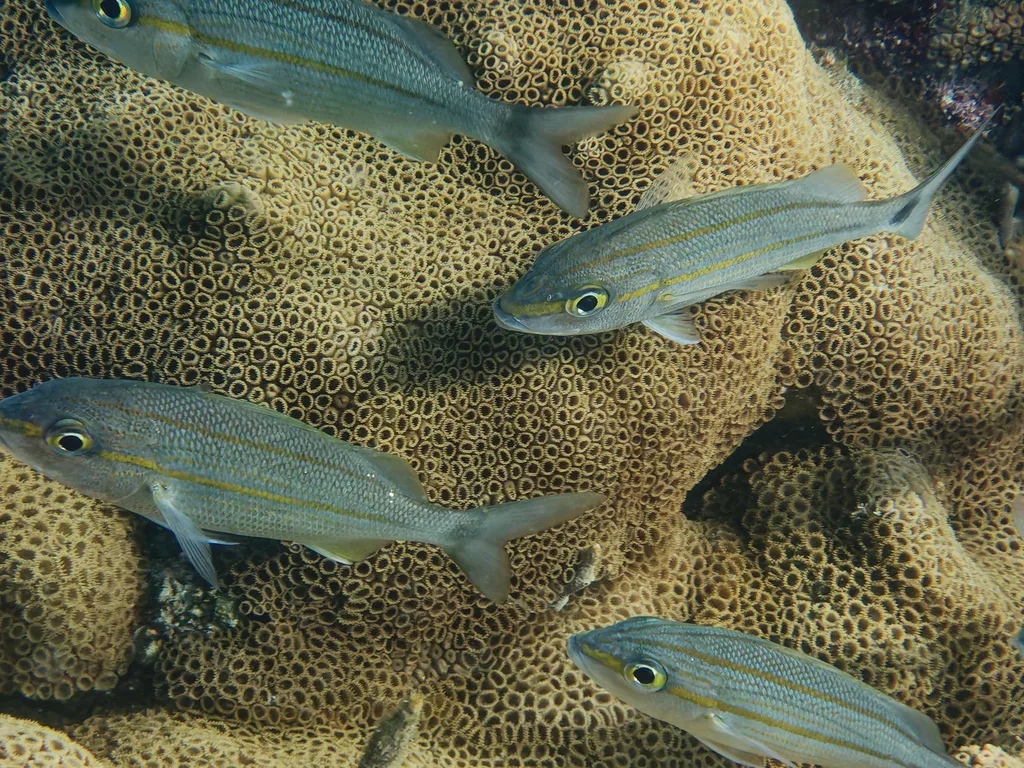
Small fusiform grunt, silvery white with a yellow mid-lateral stripe running from the eye to a large round black spot at the tail base, plus a narrower yellow stripe above the lateral line; dorsal fin 13 spines and 15 soft rays, anal fin 3 spines and 9 soft rays
- Family
- Haemulidae (grunts)
- IUCN Red List category
- Least Concern
- Size
- Typically 12–20 cm (5–8 in); common length 18 cm TL (7 in), maximum 28 cm TL (11 in); matures at about 14 cm; maximum reported age 9 years.
- Depth range
- 2–20 m; Published accounts give 30–70 m.
- Habitat
- Marine, reef-associated; seagrass beds, sand flats and patch reefs.
- Diet
- Small crustaceans, mollusks and other benthic invertebrates, plus plankton and algae.
- Geographic range
- Caribbean, Bahamas, Florida and Bermuda; Western Atlantic from Massachusetts and Bermuda through the Gulf of Mexico to Brazil, and the most abundant Haemulon along Florida's east coast.
- Maximum weight
- 85.6 g
- Wild longevity
- 9 years
- Trophic level
- 3.19
- Vulnerability index
- 49.6
- Human hazard
- Reports of ciguatera poisoning
- Reproductive mode
- Separate sexes; External fertilization; Monogamy; Eggs or young are not guarded; Eggs scattered in open water or on the substrate
- Common name in Spanish
- Bocayate muellito, Cacharo, Cuji, Jeniguano, Jeniguano bocón, Maruca, Mariquita, Mula, Mulita, Ronco bravo, Ronco, Ronco jeniguano, Ronco jeníguano, Zafiro
- Common name in French
- Gorette tomtate
02 / NATURAL HISTORY
Field notes
Biology and ecology, shown where information is available for this species.
Abundant small predator of invertebrates and commonly used as bait, linking benthic prey to larger fishes and fisheries.
Schooling fish
Oviparous with distinct pairing during breeding; fecundity estimated around 29,000 eggs; matures at about 14 cm.
Cottonwick (H. melanurum): has a broad black band from the dorsal-fin origin to the lower tail lobe rather than a round black tail spot; Caesar Grunt (H. carbonarium): gray body with brownish fins and no black caudal spot.
LC – Least Concern; Published accounts rate fishing vulnerability moderate to high
Recorded food groups and items (11)
- plants
- other plants
- benthic algae/weeds
- small crustaceans
- zoobenthos
- benthic crust.
- mollusks
- other benthic invertebrates
- Amathia distans
- zooplankton
- other planktonic invertebrates
Reported countries and territories (37)
- Anguilla
- Antigua and Barbuda
- Aruba
- Bahamas
- Barbados
- Belize
- Bermuda
- British Virgin Islands
- Cayman Islands
- Colombia
- Costa Rica
- Cuba
- Curaçao
- Dominica
- Dominican Republic
- French Guiana
- Grenada
- Guadeloupe
- Guatemala
- Guyana
- Haiti
- Honduras
- Jamaica
- Martinique
- Mexico
- Montserrat
- Nicaragua
- Panama
- Puerto Rico
- Saint Kitts and Nevis
- Saint Lucia
- Saint Vincent and the Grenadines
- Suriname
- Trinidad and Tobago
- Turks and Caicos Islands
- United States Virgin Islands
- Venezuela
TL means total length; SL excludes the tail fin; FL measures to the tail fork. These measurements are not interchangeable.
CARIBBEAN REEF FISH FOUNDATION
From field knowledge
to reef action.
Explore the Foundation’s current conservation and research work.