
01 / SPECIES PROFILE
Species Overview
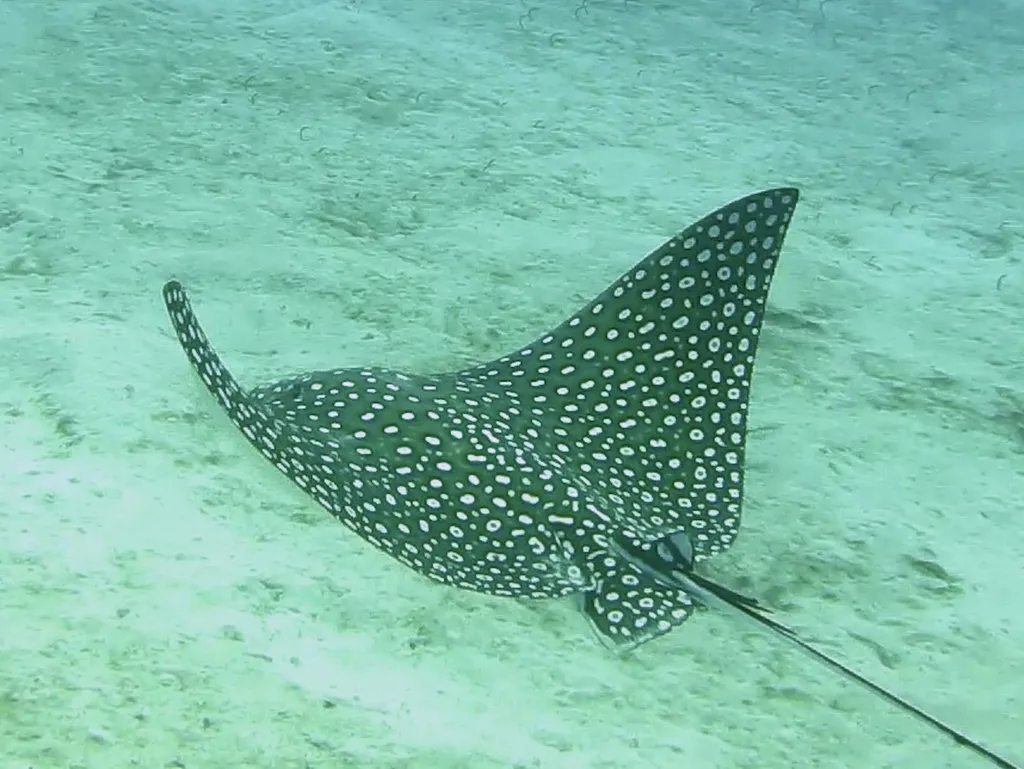
Angular disc about twice as wide as long, dark (black, gray or brown) above with many small white to bluish spots or rings, white below; thick head with a long duckbill-like snout; long whip-like tail with 2–6 venomous barbed spines behind a small dorsal fin; smooth skin
- Family
- Aetobatidae
- Size
- Typical adult 1.2–2.5 m [4–8 ft]; common 140 cm DW [55 in], maximum 230 cm DW [91 in], while Published accounts give up to about 3 m DW [9.8 ft]; max published weight 230 kg [507 lb].
- Depth range
- 3–25 m; Published accounts give 1–80 m, commonly to at least 60 m.
- Habitat
- Coastal waters over coral reefs and in bays, occasionally estuaries, but spends much time in open water; marine and brackish.
- Diet
- Bivalves (clams, oysters), gastropods, shrimps, octopus, squid, polychaetes, sea urchins and small bony fishes; digs with its snout and crushes shells with plate-like chevron teeth.
- Geographic range
- Caribbean, Bahamas, Florida, Bermuda, Gulf of America; western Atlantic from North Carolina to Brazil; eastern Atlantic probable
- Maximum weight
- 230 kg
- Trophic level
- 3.32
- Vulnerability index
- 73.62
- Human hazard
- Traumatogenic (can cause injury)
- Reproductive mode
- Separate sexes; Internal fertilization; Carries developing eggs or young; Internal live-bearing
- Common name in Spanish
- Chucho, Chucho pintado, Gavilan pintado, Obispo, Raya, Raya aguila, Raya águila, Raya gavilán, Raya murciélago moteada, Raya pico de pato, Wakawa
- Common name in French
- Aigle de mer léopard, Aigle de mer tacheté, Aigle de mer tachetée, Raie aigle, Raie chauve-souris, Raie léopard, Raie noire
02 / NATURAL HISTORY
Field notes
Biology and ecology, shown where information is available for this species.
Pups born at 17–35 cm disc width.
Predator of shellfish and other benthic invertebrates; its pups are prey for sharks such as great hammerheads and silvertips.
Forms large schools outside the breeding season, often near the surface; swims long distances, may leap clear of the water; shy and wary of divers; shows high site fidelity.
Ovoviviparous (aplacental viviparity), embryos nourished by yolk; litters up to 4 pups; males chase and bite the female's pectoral fin during courtship, with copulation lasting about 20–90 seconds.
Southern Eagle Ray (Myliobatis goodei): dorsal fin starts well behind the pelvic fins; Bullnose Ray (M. freminvillii): dorsal fin starts near rear pelvic margins and it is absent from most of the Caribbean; neither has the white-spotted back.
EN – Endangered; threats include capture in trawls, trammel nets and longlines and high fishing vulnerability
Recorded food groups and items (6)
- zoobenthos
- mollusks
- bivalves
- Aliger gigas
- gastropods
- other benthic invertebrates
Reported countries and territories (37)
- Anguilla
- Antigua and Barbuda
- Aruba
- Bahamas
- Barbados
- Belize
- Bermuda
- British Virgin Islands
- Cayman Islands
- Colombia
- Costa Rica
- Cuba
- Curaçao
- Dominica
- Dominican Republic
- French Guiana
- Grenada
- Guadeloupe
- Guatemala
- Guyana
- Haiti
- Honduras
- Jamaica
- Martinique
- Mexico
- Montserrat
- Nicaragua
- Panama
- Puerto Rico
- Saint Kitts and Nevis
- Saint Lucia
- Saint Vincent and the Grenadines
- Suriname
- Trinidad and Tobago
- Turks and Caicos Islands
- United States Virgin Islands
- Venezuela
TL means total length; SL excludes the tail fin; FL measures to the tail fork. These measurements are not interchangeable.
CARIBBEAN REEF FISH FOUNDATION
From field knowledge
to reef action.
Explore the Foundation’s current conservation and research work.