
01 / SPECIES PROFILE
Species Overview
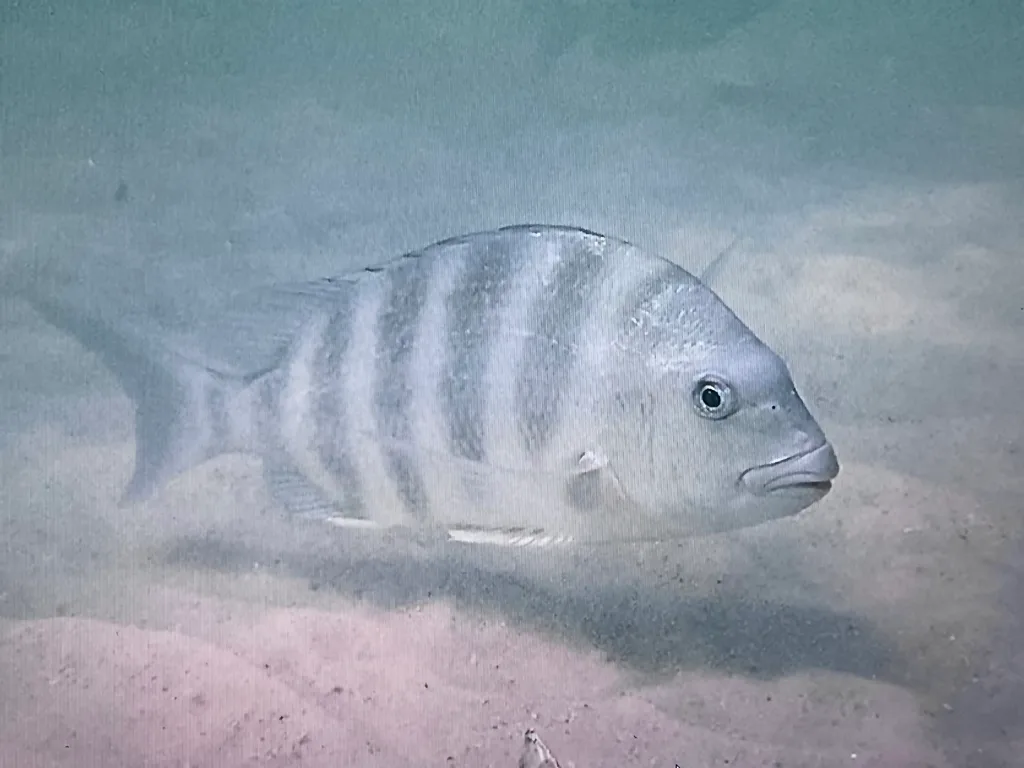
Deep, oval-bodied porgy with a blunt snout and small, nearly horizontal mouth; silvery to greenish-yellow with an olive back and five or six dark vertical crossbars; dorsal, anal and pelvic fins dusky to black; strong incisor-like front teeth and rows of molars for crushing shells
- Family
- Sparidae
- IUCN Red List category
- Least Concern
- Size
- Typical adult 35-46 cm (14-18 in), commonly 0.5-3.6 kg; common length 35 cm TL; maximum recorded 91 cm TL (36 in) and 9.6 kg.
- Depth range
- 1-12 m; Published accounts give depth to 15 m or more.
- Habitat
- Inshore marine and brackish waters: bays, estuaries, tidal creeks, mangrove roots, and around pilings, piers, jetties and rocky shores; sometimes enters fresh water, especially in winter; intolerant of low dissolved oxygen.
- Diet
- Omnivore; adults crush mollusks and crustaceans (blue crabs, oysters, clams) and scrape barnacles off pilings, also taking small fish; juveniles eat zooplankton, polychaetes, copepods, midge larvae and algae.
- Geographic range
- Caribbean: scarce along Central and South American Caribbean coasts; absent from the Bahamas, West Indies, Grenada and Bermuda; wider Atlantic: Nova Scotia (Canada) through the Gulf of America to Brazil, densest off southwest Florida
- Maximum weight
- 9.6 kg
- Trophic level
- 3.53
- Vulnerability index
- 36.43
- Human hazard
- Harmless
- Common name in Spanish
- Sargo, Sargo chopa
- Common name in French
- Rondeau mouton
02 / NATURAL HISTORY
Field notes
Biology and ecology, shown where information is available for this species.
Dark crossbars are most distinct in young fish; juveniles live over seagrass flats and mud bottoms and move to jetties, piers and pilings at about 50 mm; maturity at about 2 years; lifespan at least 20 years.
Important estuarine predator of shellfish and barnacles on hard structure; prey for sharks and other large predatory fishes.
Adults gather around structure such as pilings and jetties and migrate offshore to spawn, then return inshore
Spawns offshore in late winter to early spring, sometimes over artificial reefs and navigation markers; females spawn as often as daily, releasing 1,100-250,000 buoyant eggs (about 0.8 mm) per event, which hatch in about 28 hours at 23°C.
Black Drum (Pogonias cromis) has chin barbels, grows much larger and its bars fade with age; Atlantic Spadefish (Chaetodipterus faber) has a very short snout, rounder body and taller soft dorsal and anal fins.
LC – Least Concern; vulnerable to periodic low-oxygen fish kills in estuaries; supports commercial and recreational fisheries
Recorded food groups and items (5)
- Portunus gibbesii
- zoobenthos
- benthic crust.
- crabs
- mollusks
Reported countries and territories (16)
- Aruba
- Belize
- Colombia
- Costa Rica
- Curaçao
- French Guiana
- Grenada
- Guatemala
- Guyana
- Honduras
- Mexico
- Nicaragua
- Panama
- Suriname
- Trinidad and Tobago
- Venezuela
TL means total length; SL excludes the tail fin; FL measures to the tail fork. These measurements are not interchangeable.
CARIBBEAN REEF FISH FOUNDATION
From field knowledge
to reef action.
Explore the Foundation’s current conservation and research work.