
01 / SPECIES PROFILE
Species Overview
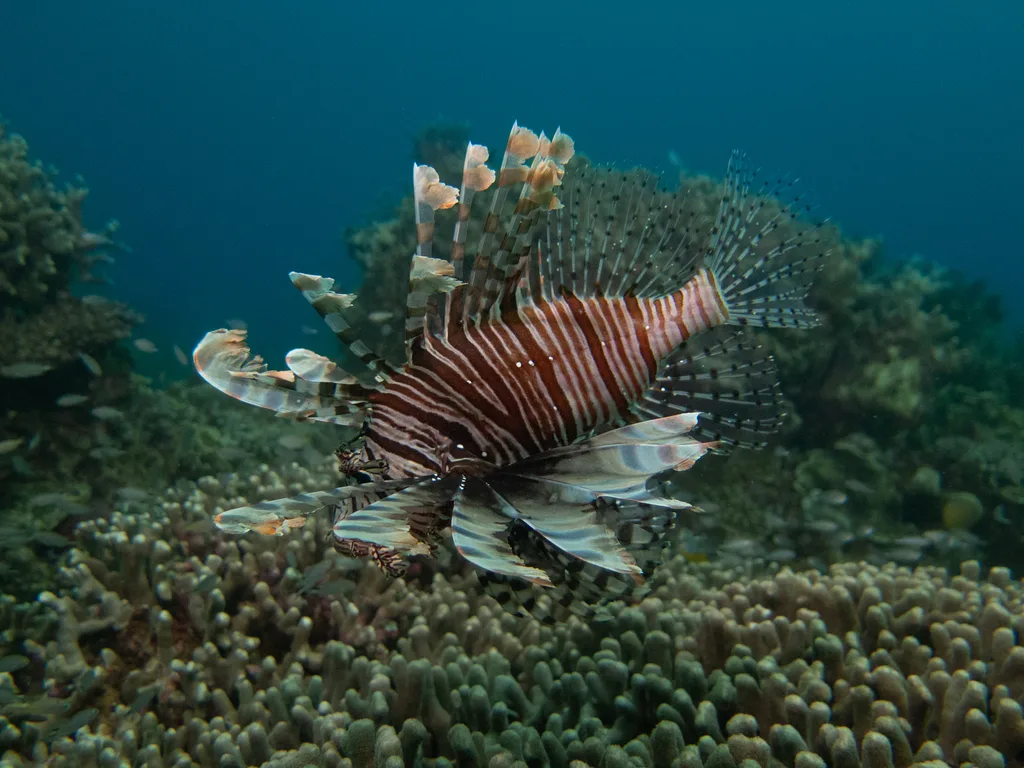
Almond-shaped body with red/maroon and white zebra-like vertical bands, long separated venomous dorsal spines (13), large fan-like pectoral fins with unbranched rays, often large tentacles over the eyes, and spotted soft dorsal, anal and tail fins; inshore/estuarine fish can be much darker, even nearly black
- Family
- Scorpaenidae
- Size
- 18–38 cm [7–15 in]; maximum 45.7 cm TL [18 in]; Published accounts give maximum about 30–38 cm TL. Lifespan up to 10 years.
- Depth range
- 12–45 m; 2–55 m (habitat noted to about 50 m).
- Habitat
- Coral and rocky reefs in lagoons and on seaward reefs, near- and offshore, including turbid inshore areas, bays, estuaries and harbors; shelters under ledges, in caves and crevices by day.
- Diet
- Small fishes, shrimps and crabs; herds prey into a corner with its spread pectoral fins, then swallows it whole with a fast strike; cannibalism observed; trophic level 4.4.
- Geographic range
- Native to the Indo-West Pacific (eastern Indian Ocean to the Marquesas, north to Japan, south to New Zealand). Invasive in Florida, the Bahamas and the Caribbean; first US Atlantic reports off North Carolina in 2000, since recorded from South Florida to Long Island, NY, Bahamas and Turks and Caicos.
- Maximum weight
- 1.4 kg
- Wild longevity
- 10 years
- Trophic level
- 3.44
- Vulnerability index
- 34.43
- Human hazard
- Venomous
- Reproductive mode
- Separate sexes; External fertilization; Eggs or young are not guarded; Eggs scattered in open water or on the substrate
- Common name in Spanish
- Pez león
- Common name in French
- Laffe volant, Poisson scorpion, Poisson volant, Poisson-dindon, Rascasse volante
02 / NATURAL HISTORY
Field notes
Biology and ecology, shown where information is available for this species.
has juvenile photos. Juveniles are pelagic and disperse widely; larvae are planktonic and (based on P. miles) settle after about 25–40 days at 10–12 mm. Maturity at about 16 cm.
Top-level ambush predator of small reef fishes and crustaceans; in the invaded Atlantic it has few or no known predators and its effects on native reef communities are under study.
Usually solitary; rests by day almost motionless, often head-down in sheltered spots, and hunts mainly at night though daytime feeding is seen; approaches threats with venomous spines pointed forward.
External fertilization after poorly documented courtship; releases a floating egg mass; planktonic larvae
Devil firefish (Pterois miles), also part of the Atlantic invasion, is near-identical: P. volitans almost always has 11½ dorsal and 7½ anal fin rays, versus usually 10½ and 6½ in P. miles (FAO key); also notes P. volitans has larger fin spots.
LC – Least Concern (native range, assessed 2015). Invasive in the western Atlantic, where non-native populations grew about 50% in 2004–2006.
Recorded food groups and items (20)
- Apogonidae
- nekton
- finfish
- bony fish
- fishes
- Coryphopterus eidolon
- Coryphopterus personatus/hyalinus
- Gramma loreto
- Halichoeres garnoti
- Thalassoma bifasciatum
- crabs
- zoobenthos
- benthic crust.
- Natantia
- shrimps/prawns
- Penaeus
- Stenopus hispidus
- Zoea
- zooplankton
- planktonic crust.
Reported countries and territories (20)
- Antigua and Barbuda
- Bahamas
- Belize
- Bermuda
- Cayman Islands
- Colombia
- Costa Rica
- Cuba
- Curaçao
- Dominican Republic
- Haiti
- Honduras
- Jamaica
- Mexico
- Nicaragua
- Panama
- Puerto Rico
- Turks and Caicos Islands
- United States Virgin Islands
- Venezuela
TL means total length; SL excludes the tail fin; FL measures to the tail fork. These measurements are not interchangeable.
CARIBBEAN REEF FISH FOUNDATION
From field knowledge
to reef action.
Explore the Foundation’s current conservation and research work.