
01 / SPECIES PROFILE
Species Overview
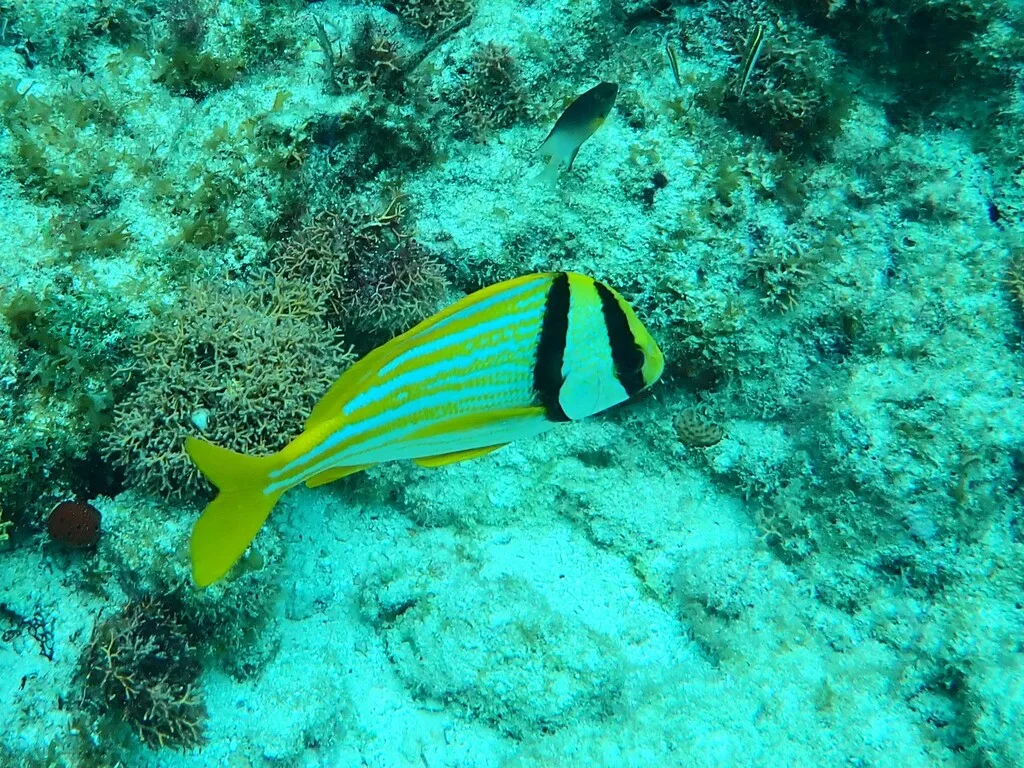
Deep-bodied grunt with a blunt snout and thick lips, striped yellow and silvery blue with yellow fins and head, and two black bars: one from the nape through the eye to the mouth and one from the dorsal-fin origin to the pectoral-fin base
- Family
- Haemulidae (grunts)
- IUCN Red List category
- Least Concern
- Size
- Typically 15–25 cm [6–10 in]; common 25 cm TL [9.8 in], maximum 40.6 cm TL [16 in] and 930 g.
- Depth range
- 2–70 m; typically 2–20 m; 3–21 m.
- Habitat
- Shallow inshore reefs and rocky bottoms, also mangroves; marine and brackish.
- Diet
- Feeds at night on mollusks, echinoderms, and crustaceans; juveniles eat parasites picked from other fishes.
- Geographic range
- Western Atlantic from Florida to Brazil, including the Gulf of Mexico, Caribbean and Bahamas; introduced in Bermuda.
- Maximum weight
- 930 g
- Trophic level
- 3.44
- Vulnerability index
- 38
- Human hazard
- Reports of ciguatera poisoning
- Reproductive mode
- Separate sexes; External fertilization; Eggs or young are not guarded; Eggs scattered in open water or on the substrate
- Common name in Spanish
- Arroz con coco, Burro catalina, Burro payaso, Cabomartin, Canario, Catalina, Catalineata, Catalineta, Ronco
- Common name in French
- Lippu rondeau, Palriot, Rondeau
02 / NATURAL HISTORY
Field notes
Biology and ecology, shown where information is available for this species.
Juveniles (shown on) lack the black bars and instead have two horizontal black stripes, a large dark blotch near the tail base and a bright yellow head.
Nocturnal invertebrate predator; juvenile cleaners remove parasites; prey for snappers, groupers and sharks.
Nocturnal; forms large schools, sometimes mixed with White Grunts; curious and easily approached by divers; juveniles act as cleaners.
Forms distinct pairs during breeding; little is known about spawning; larvae have a distinctive spot on the tail fin.
The only Caribbean/Atlantic grunt with two black vertical bars and yellow stripes; juveniles resemble other striped juvenile grunts but have a yellow head and large tail blotch; Black Margate (A. surinamensis) is the dark-bodied congener without bars.
LC – Least Concern. Minor commercial and game fishery; young collected for the aquarium trade.
Recorded food groups and items (6)
- zoobenthos
- benthic crust.
- echinoderms
- mollusks
- other benthic invertebrates
- worms
Reported countries and territories (37)
- Anguilla
- Antigua and Barbuda
- Aruba
- Bahamas
- Barbados
- Belize
- Bermuda
- British Virgin Islands
- Cayman Islands
- Colombia
- Costa Rica
- Cuba
- Curaçao
- Dominica
- Dominican Republic
- French Guiana
- Grenada
- Guadeloupe
- Guatemala
- Guyana
- Haiti
- Honduras
- Jamaica
- Martinique
- Mexico
- Montserrat
- Nicaragua
- Panama
- Puerto Rico
- Saint Kitts and Nevis
- Saint Lucia
- Saint Vincent and the Grenadines
- Suriname
- Trinidad and Tobago
- Turks and Caicos Islands
- United States Virgin Islands
- Venezuela
TL means total length; SL excludes the tail fin; FL measures to the tail fork. These measurements are not interchangeable.
CARIBBEAN REEF FISH FOUNDATION
From field knowledge
to reef action.
Explore the Foundation’s current conservation and research work.