
01 / SPECIES PROFILE
Species Overview
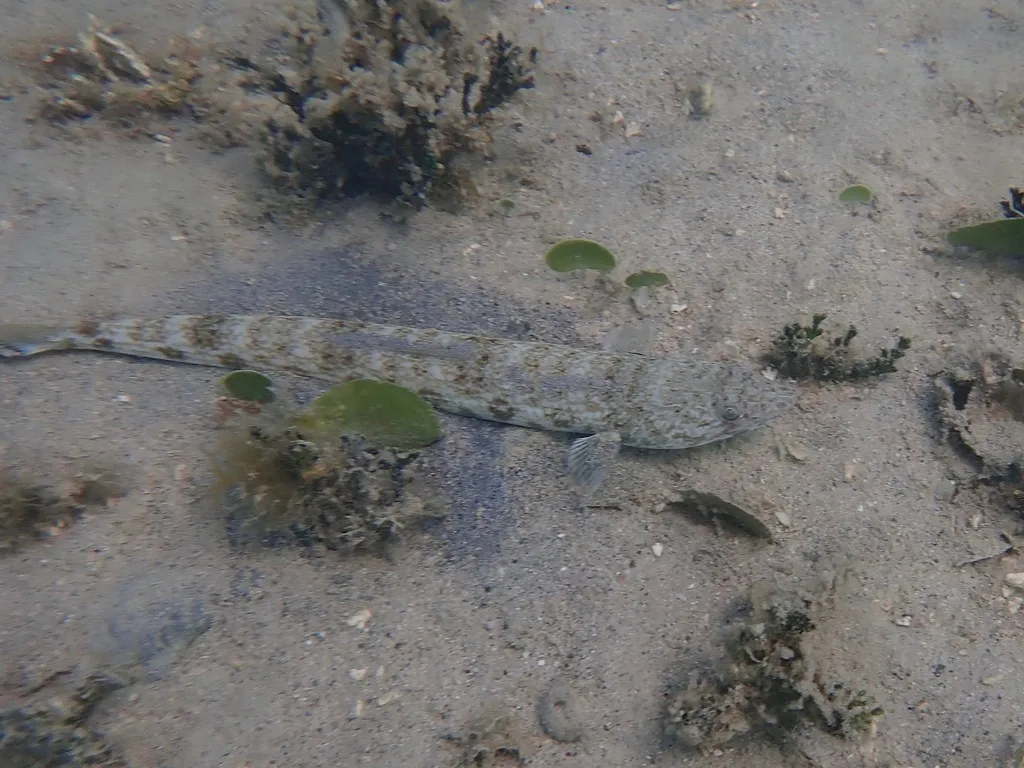
Elongate, cylindrical body with a flattened head, pointed snout and very large mouth full of large, sharp, depressible teeth; back brownish to olive with a greenish cast, about 8 faint blotches along the mid-side that fade with age, belly white, silvery or yellowish; dark spot toward the rear of the adipose fin; no fin spines (dorsal 10-13 soft rays, anal 11-13)
- Family
- Synodontidae
- IUCN Red List category
- Least Concern
- Size
- Common length 30 cm TL (12 in); maximum recorded 53.8 cm TL (21 in), max weight 900 g; Published accounts give up to 35 cm (14 in).
- Depth range
- 0-200 m; 2-180 m.
- Habitat
- Marine and brackish, reef-associated; sand flats among seagrass, shallow bays, saltwater creeks and lagoon channels, where it burrows into the sediment; tolerates salinity of 4-60 ppt.
- Diet
- Mostly fishes, also shrimps, crabs and cephalopods (trophic level 4.5).
- Geographic range
- Caribbean: Bahamas and Caribbean; wider Atlantic: western Atlantic from Massachusetts and the northern Gulf of Mexico to Brazil
- Maximum weight
- 900 g
- Trophic level
- 4.43
- Vulnerability index
- 35.03
- Human hazard
- Harmless
- Spawning seasonality
- throughout the year, but peaking once
- Reproductive mode
- Separate sexes; External fertilization; Eggs or young are not guarded; Eggs scattered in open water or on the substrate
- Common name in Spanish
- Chile apestoso, Doncella, Guaripete, Guaripete común, Guavina, Lagarto, Lagarto costero, Lagarto máximo, Lagarto playero, Manuelito, Pez lagarto, Rano
- Common name in French
- Anolis des plages
02 / NATURAL HISTORY
Field notes
Biology and ecology, shown where information is available for this species.
Juveniles are pelagic and often occur near land; newly hatched larvae are found near the surface over 27-46 m water; mature at about 19 cm TL..
High-level predator (trophic level 4.5) of small fishes and crustaceans on sand and seagrass flats.
Solitary ambush predator that lurks in shallow bays and near-shore waters; buries itself in bottom sediments
Oviparous (egg-laying) with pelagic larvae found near the surface; maturity at about 19 cm TL
Sand Diver (Synodus intermedius) is a similar Caribbean lizardfish; Sand Diver has a small rectangular black blotch at the shoulder and yellow stripes along the body, which are not described for the Inshore Lizardfish.
LC – Least Concern; Published accounts rate fishing vulnerability as moderate
Recorded food groups and items (7)
- Menidia beryllina
- nekton
- finfish
- bony fish
- Anchoa mitchilli
- Gobiosoma robustum
- Aluterus schoepfii
Reported countries and territories (20)
- Aruba
- Bahamas
- Barbados
- Belize
- Bermuda
- Colombia
- Cuba
- Curaçao
- French Guiana
- Guyana
- Haiti
- Jamaica
- Mexico
- Nicaragua
- Panama
- Puerto Rico
- Saint Lucia
- Suriname
- Trinidad and Tobago
- Venezuela
TL means total length; SL excludes the tail fin; FL measures to the tail fork. These measurements are not interchangeable.
CARIBBEAN REEF FISH FOUNDATION
From field knowledge
to reef action.
Explore the Foundation’s current conservation and research work.