
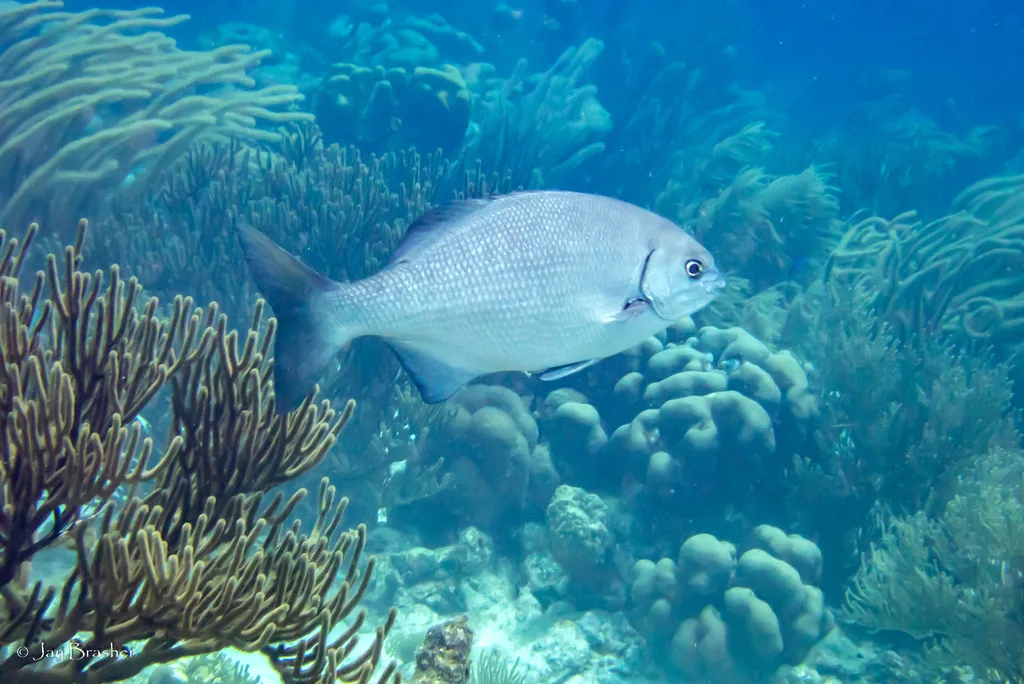
01 / SPECIES PROFILE
Species Overview
Deep, laterally compressed body with a terminal, nearly oblique mouth; brownish to silvery with dusky unpaired fins whose dark edges become stronger in adults; a white/silvery streak runs across the cheek below the eye. Dorsal fin XI, 11-12; anal fin III, 10-12
- Family
- Kyphosidae
- IUCN Red List category
- Least Concern
- Size
- Typical adult 30-60 cm [12-24 in]; maximum recorded 75 cm TL [29.5 in], max published weight 1.9 kg.
- Depth range
- 6-25 m; Published accounts give 2 m to an unspecified maximum.
- Habitat
- Marine, reef-associated and oceanodromous; noted around exposed seaward reefs of isolated high islands.
- Diet
- Herbivore feeding on brown algae such as Sargassum and Turbinaria; trophic level 2.0.
- Geographic range
- Caribbean, Florida and Gulf of America; Published accounts describe an Indo-Pacific, antitropical range (Red Sea, South Africa, Australia, southern Japan) and does not mention the Atlantic.
- Maximum weight
- 1.9 kg
- Trophic level
- 2.56
- Vulnerability index
- 54.36
- Human hazard
- Harmless
- Reproductive mode
- Separate sexes; External fertilization; Eggs or young are not guarded; Eggs scattered in open water or on the substrate
- Common name in French
- Petit wiwa
02 / NATURAL HISTORY
Field notes
Biology and ecology, shown where information is available for this species.
dark fin margins become more pronounced with age. Length at maturity about 36 cm (range 34-38 cm).
Reef herbivore that grazes macroalgae (trophic level 2.0).
Oviparous (egg-laying)
Bermuda Chub (K. sectatrix): gray with faint yellow side lines and a yellow line from mouth corner to preopercle, versus brownish body, dark-edged fins and white cheek streak in Gray Chub; Brassy Chub (K. vaigiensis): golden horizontal lines and a very low dorsal fin with 13-15 soft rays versus 11-12 in Gray Chub.
LC – Least Concern. Published accounts rate resilience as low (population doubling 4.5-14 years) and fishing vulnerability as moderate to high; it is fished commercially, as a gamefish and for the aquarium trade.
Recorded food groups and items (9)
- Polysiphonia
- plants
- other plants
- benthic algae/weeds
- Sargassum
- Turbinaria
- zoobenthos
- benthic crust.
- worms
TL means total length; SL excludes the tail fin; FL measures to the tail fork. These measurements are not interchangeable.
CARIBBEAN REEF FISH FOUNDATION
From field knowledge
to reef action.
Explore the Foundation’s current conservation and research work.