
01 / SPECIES PROFILE
Species Overview
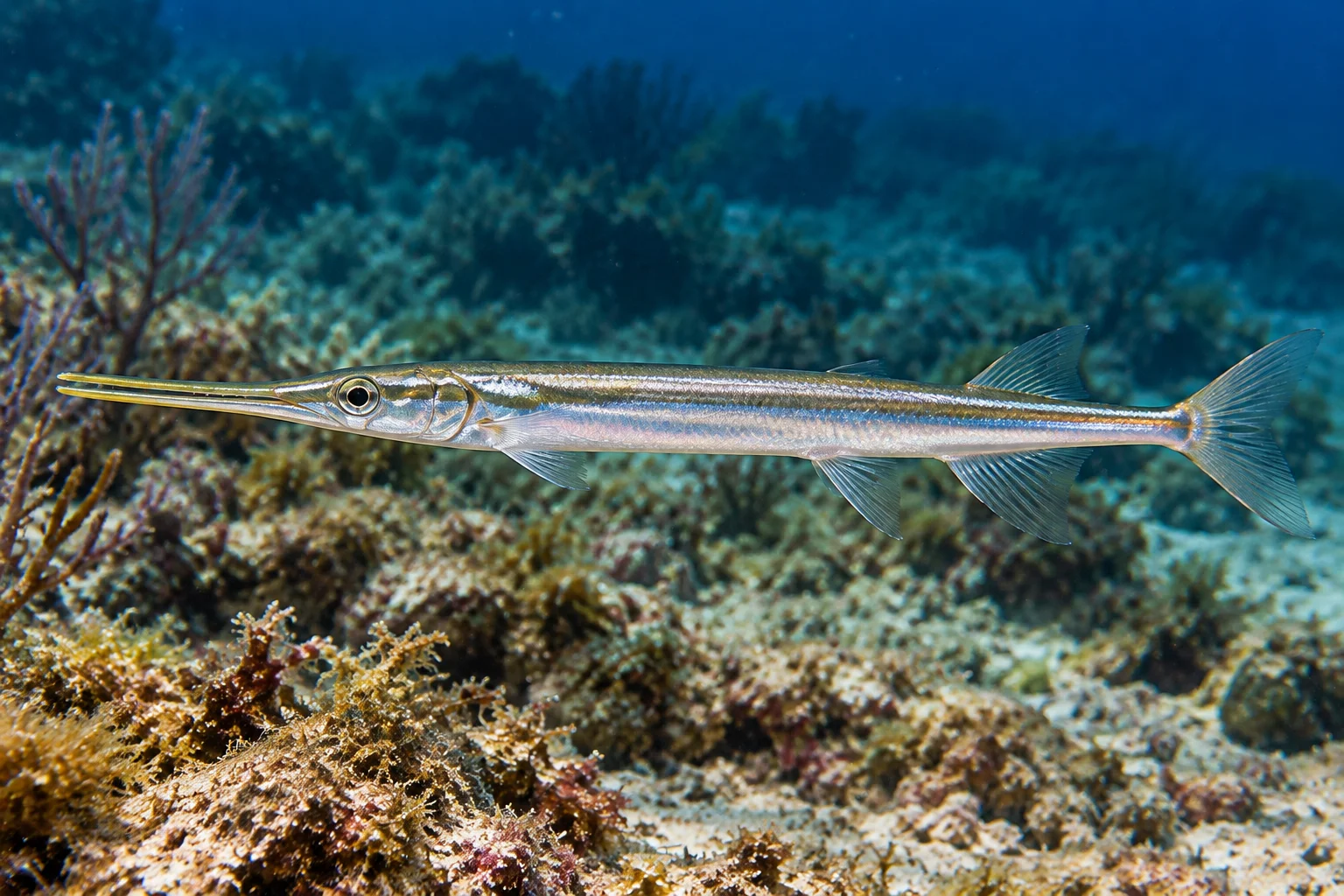
Very long, strongly laterally flattened needlefish with long beak-like jaws; dark blue back and silvery-white belly, with about 12-14 dark vertical bars and black blotches mid-body; high sickle-shaped front lobes on the dorsal and anal fins and sickle-shaped pectorals; no fin spines (dorsal 23-26, anal 24-28 soft rays)
- Family
- Belonidae
- IUCN Red List category
- Least Concern
- Size
- Typically 30-90 cm (12-35 in); common length 70 cm SL; maximum recorded 140 cm TL (55 in) and 4.8 kg.
- Depth range
- 0-3 m; Published accounts give 0-10 m.
- Habitat
- Near-surface waters of neritic and oceanic areas, more often around islands; also enters estuaries and coastal rivers; reef-associated, marine and brackish.
- Diet
- Mainly small fishes.
- Geographic range
- Florida, Bahamas, Bermuda and throughout the Caribbean to Brazil and the Gulf; circumtropical in tropical and warm-temperate seas including the eastern Atlantic, Indian and Pacific Oceans.
- Maximum weight
- 4.8 kg
- Trophic level
- 4.22
- Vulnerability index
- 39.61
- Human hazard
- Harmless
- Reproductive mode
- Separate sexes; External fertilization; Eggs or young are not guarded; Eggs scattered in open water or on the substrate
- Common name in Spanish
- Aguja, Aguja americana, Aguja corbata, Agujon, Agujón, Agujón de golfo, Agujón sable, Carajota, Guama, Marao machete, Tijeras, Tijerilla
- Common name in French
- Anguille plate, Orphie coutelas, Orphie plate
02 / NATURAL HISTORY
Field notes
Biology and ecology, shown where information is available for this species.
Juveniles and adults both carry a raised black lobe at the rear of the dorsal fin
Upper-level surface predator of small fishes (trophic level about 4.2).
Surface-dwelling; sometimes forms large schools; attracted to lights at night, which is how it is usually caught
Oviparous; eggs bear surface filaments that attach them to floating or fixed objects; only the left gonad develops in females.
Other regional needlefishes (e.g. Redfin Needlefish, Strongylura notata); the Flat Needlefish is set apart by its strongly compressed, flat body, 12-14 dark vertical bars and the black lobe at the rear of the dorsal fin.
LC – Least Concern
Recorded food groups and items (11)
- nekton
- cephalopods
- squids/cuttlefish
- finfish
- bony fish
- zoobenthos
- benthic crust.
- stomatopods
- zooplankton
- planktonic crust.
- euphausiids
Reported countries and territories (37)
- Anguilla
- Antigua and Barbuda
- Aruba
- Bahamas
- Barbados
- Belize
- Bermuda
- British Virgin Islands
- Cayman Islands
- Colombia
- Costa Rica
- Cuba
- Curaçao
- Dominica
- Dominican Republic
- French Guiana
- Grenada
- Guadeloupe
- Guatemala
- Guyana
- Haiti
- Honduras
- Jamaica
- Martinique
- Mexico
- Montserrat
- Nicaragua
- Panama
- Puerto Rico
- Saint Kitts and Nevis
- Saint Lucia
- Saint Vincent and the Grenadines
- Suriname
- Trinidad and Tobago
- Turks and Caicos Islands
- United States Virgin Islands
- Venezuela
TL means total length; SL excludes the tail fin; FL measures to the tail fork. These measurements are not interchangeable.
CARIBBEAN REEF FISH FOUNDATION
From field knowledge
to reef action.
Explore the Foundation’s current conservation and research work.