
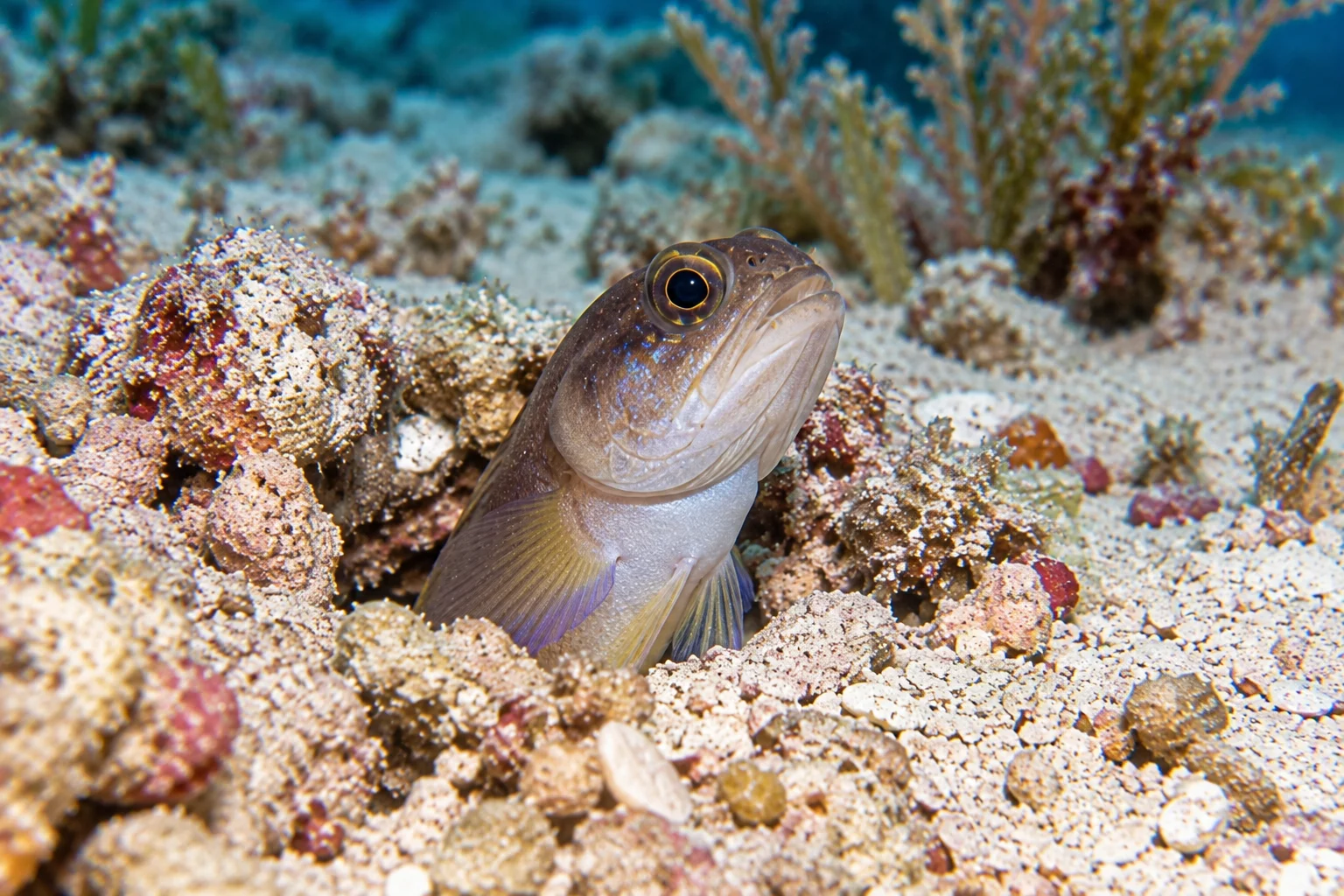
01 / SPECIES PROFILE
Species Overview
Elongate body densely mottled dark brown and flecked with black; dark (deep greenish-blue in life) spot on the dorsal fin, usually between the 2nd and 4th/5th spines; tail and rear dorsal fin yellow with rows of small black spots
- Family
- Opistognathidae
- IUCN Red List category
- Least Concern
- Size
- Up to 10 cm (4 in); maximum 14.0 cm TL (5.5 in).
- Depth range
- 1–12 m; 0–8 m.
- Habitat
- Rock and sand bottoms or the eroding edges of weed beds.
- Diet
- Diet includes bottom-dwelling crustaceans, bony fishes and echinoderms.
- Geographic range
- Caribbean, Bahamas, Florida, Brazil; Western Atlantic, southern Florida and the Bahamas to northern South America.
- Vulnerability index
- 10
- Human hazard
- Harmless
- Reproductive mode
- Separate sexes; External fertilization; Carries developing eggs or young; External brooding
- Common name in Spanish
- Bocón prieto, Guardián escamudo
02 / NATURAL HISTORY
Field notes
Biology and ecology, shown where information is available for this species.
Mouthbrooder; males incubate the egg mass in their mouths.
Banded Jawfish (O. macrognathus): dorsal spot further back (6th–7th to 9th spine), males with a long banded jaw extension, and grows larger (to 20 cm TL).
LC – Least Concern
Reported countries and territories (6)
- Bahamas
- Cuba
- Mexico
- Puerto Rico
- Trinidad and Tobago
- Venezuela
TL means total length; SL excludes the tail fin; FL measures to the tail fork. These measurements are not interchangeable.
CARIBBEAN REEF FISH FOUNDATION
From field knowledge
to reef action.
Explore the Foundation’s current conservation and research work.