
01 / SPECIES PROFILE
Species Overview
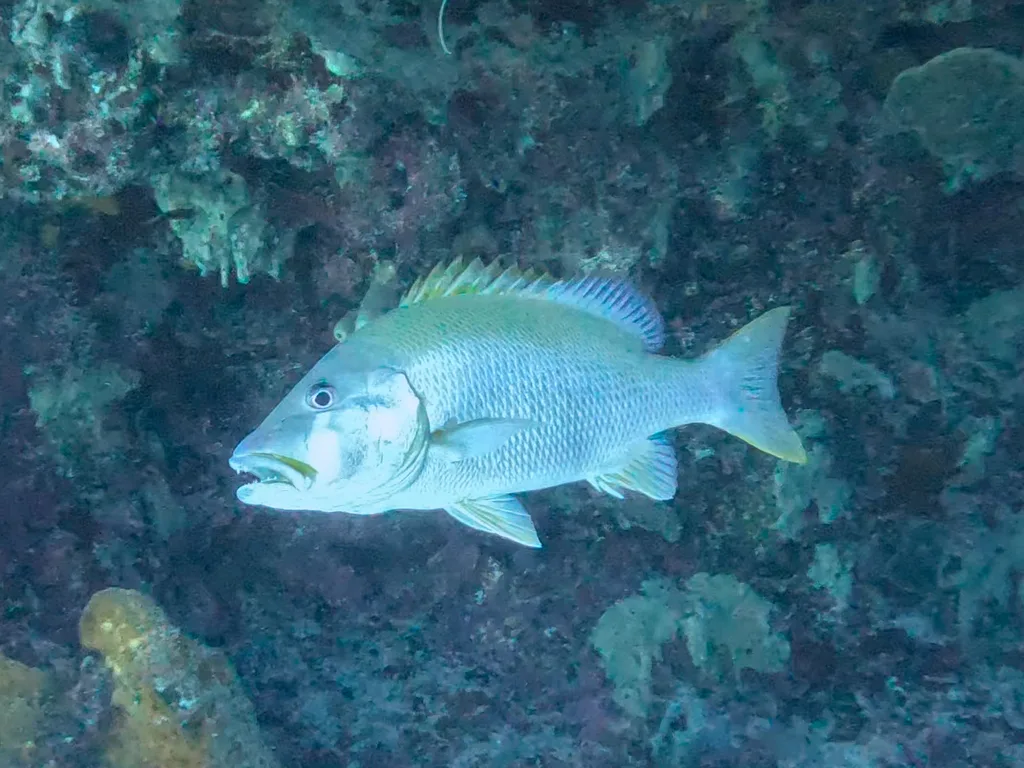
Relatively deep-bodied snapper with long pectoral fins, a weakly forked tail and rounded anal fin; one pair of enlarged upper canines visible when the mouth is closed; a pale/white triangular bar between the eye and the rear of the mouth; olive-brown back with bronze tinge, sometimes narrow pale bars, lower sides reddish-copper; dorsal X,14–15, anal III,8
- Family
- Lutjanidae
- IUCN Red List category
- Data Deficient
- Size
- Commonly 45–76 cm (1.5–2.5 ft); common length 60 cm TL (24 in); maximum 128 cm TL (50 in); max weight 28.6 kg; max age 33 years.
- Depth range
- 10–30 m; 2–40 m, usually 5–30 m.
- Habitat
- Rocky and coral reefs; juveniles in estuaries and mangroves, occasionally entering rivers and fresh water.
- Diet
- Mainly fishes plus benthic invertebrates such as shrimps, crabs, gastropods and cephalopods (trophic level about 4.4).
- Geographic range
- Caribbean, Bahamas, Florida and Gulf of Mexico; western Atlantic from Massachusetts to São Paulo, Brazil, plus eastern Atlantic islands (St. Paul's Rocks, Ascension).
- Maximum weight
- 28.6 kg
- Wild longevity
- 33 years
- Trophic level
- 3.92
- Vulnerability index
- 66.26
- Human hazard
- Reports of ciguatera poisoning
- Reproductive mode
- Separate sexes; External fertilization; Eggs or young are not guarded; Eggs scattered in open water or on the substrate
- Common name in Spanish
- Jocu, Jocú, Jocu parra, Pargo dientón, Pargo, Pargo caballera, Pargo colorado, Pargo jocu, Pargo jocú, Pargo perro, Pargo prieto, Pargo rubio, Pargo sama
- Common name in French
- Carde roulesse, Pargue dent-chien, Sarde dent chien, Vivaneau chien
02 / NATURAL HISTORY
Field notes
Biology and ecology, shown where information is available for this species.
Juveniles have a continuous horizontal blue line below the eye that breaks into a row of spots in adults; juveniles live in estuaries and mangroves.
High-level nocturnal reef predator; prey for sharks and groupers.
Solitary and wary, preferring secluded parts of the reef; feeds mainly at night (nocturnal).
Spawns mainly in March around Jamaica and the northeastern Caribbean; pelagic eggs and larvae; post-larvae settle in protected habitats before moving to reefs; maturity at 31–40 cm.
Schoolmaster (Lutjanus apodus): lacks the white triangle below the eye and keeps a continuous blue line under the eye; Cubera snapper (L. cyanopterus): gray, lacks the white triangle and blue spots under the eye.
DD – Data Deficient; low resilience and high to very high fishing vulnerability
Recorded food groups and items (13)
- nekton
- cephalopods
- squids/cuttlefish
- finfish
- zoobenthos
- benthic crust.
- crabs
- shrimps/prawns
- Strombus gigas
- mollusks
- gastropods
- Octopus vulgaris
- octopi
Reported countries and territories (37)
- Anguilla
- Antigua and Barbuda
- Aruba
- Bahamas
- Barbados
- Belize
- Bermuda
- British Virgin Islands
- Cayman Islands
- Colombia
- Costa Rica
- Cuba
- Curaçao
- Dominica
- Dominican Republic
- French Guiana
- Grenada
- Guadeloupe
- Guatemala
- Guyana
- Haiti
- Honduras
- Jamaica
- Martinique
- Mexico
- Montserrat
- Nicaragua
- Panama
- Puerto Rico
- Saint Kitts and Nevis
- Saint Lucia
- Saint Vincent and the Grenadines
- Suriname
- Trinidad and Tobago
- Turks and Caicos Islands
- United States Virgin Islands
- Venezuela
TL means total length; SL excludes the tail fin; FL measures to the tail fork. These measurements are not interchangeable.
CARIBBEAN REEF FISH FOUNDATION
From field knowledge
to reef action.
Explore the Foundation’s current conservation and research work.