
01 / SPECIES PROFILE
Species Overview
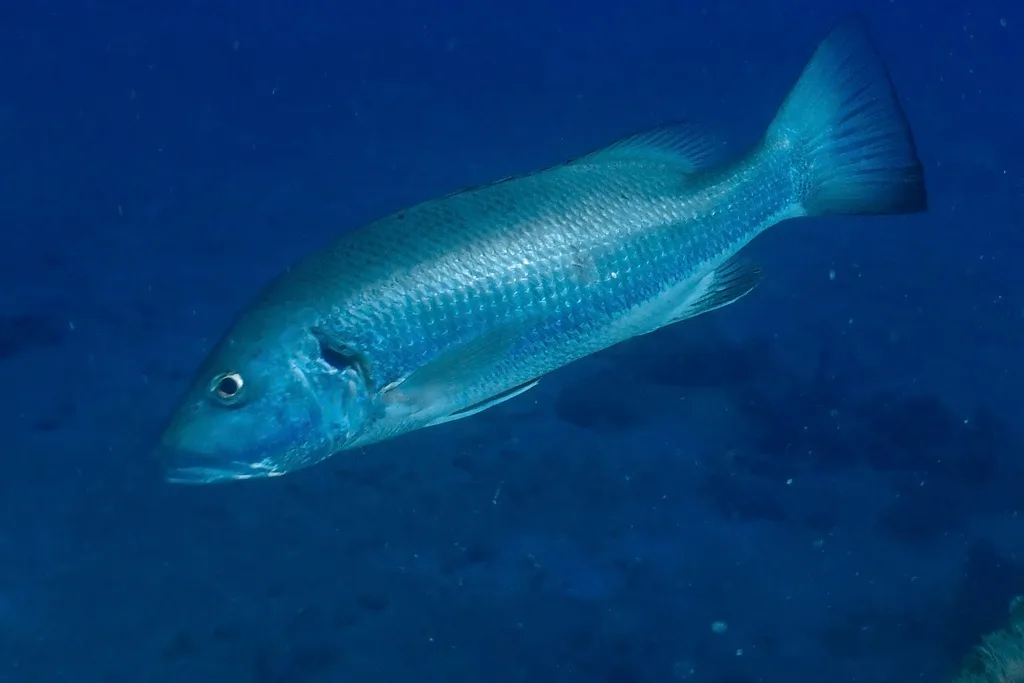
Large, elongate snapper with thick lips, strong canines (a pair visible when the mouth is closed) and a fairly truncate tail; gray to dark brown with pale to dark gray sides and a slight reddish tinge; dorsal and caudal fins grayish, anal and pelvic fins reddish/bluish; triangular vomerine tooth patch; dorsal X,14, anal III,7–8
- Family
- Lutjanidae
- IUCN Red List category
- Vulnerable
- Size
- Commonly 30–90 cm (1–3 ft); common length 90 cm TL (35 in); maximum 160 cm TL (63 in); max weight 57 kg; max age 55 years. Largest snapper in the Atlantic.
- Depth range
- 18–55 m; 18–70 m.
- Habitat
- Ledges and overhangs over rocky bottoms and reefs; young in mangroves, seagrass, estuaries and occasionally freshwater canals.
- Diet
- Fishes, shrimps, crabs and lobsters, crushed with strong canine teeth.
- Geographic range
- Caribbean, Bahamas, Florida and Bermuda; western Atlantic from Nova Scotia and Bermuda to the Amazon, rare north of Florida and apparently rare in the Gulf of Mexico.
- Maximum weight
- 57 kg
- Wild longevity
- 55 years
- Trophic level
- 3.99
- Vulnerability index
- 82.85
- Human hazard
- Reports of ciguatera poisoning
- Reproductive mode
- Separate sexes; External fertilization; Eggs or young are not guarded; Eggs scattered in open water or on the substrate
- Common name in Spanish
- Cubera, Cubereta, Guasinuco, Pargo, Pargo caballo, Pargo cubera, Pargo guacinuco, Pargo mulato
- Common name in French
- Vivaneau cubera, Vivaneau cubéra
02 / NATURAL HISTORY
Field notes
Biology and ecology, shown where information is available for this species.
Juveniles show faint side bars that fade with age; young live in mangroves and seagrass and may enter estuaries and fresh water.
Apex reef predator; its spawn is eaten by whale sharks off Belize.
Solitary, aggressive near-bottom predator that is wary and hard to approach; gathers in the hundreds only to spawn.
Spawns June–August in the Caribbean in aggregations of hundreds of fish over deep areas; eggs hatch within a day and larvae drift with currents.
Gray snapper (Lutjanus griseus): young are very similar and best separated by the vomerine tooth patch (anchor-shaped in gray, triangular in cubera); adult cuberas are far larger. Dog snapper (L. jocu): has a white triangular bar beneath the eye.
VU – Vulnerable; overfishing of spawning aggregations is the main threat; very low resilience and very high fishing vulnerability.
Recorded food groups and items (7)
- bony fish
- nekton
- finfish
- zoobenthos
- benthic crust.
- crabs
- shrimps/prawns
Reported countries and territories (36)
- Anguilla
- Antigua and Barbuda
- Aruba
- Bahamas
- Barbados
- Belize
- British Virgin Islands
- Cayman Islands
- Colombia
- Costa Rica
- Cuba
- Curaçao
- Dominica
- Dominican Republic
- French Guiana
- Grenada
- Guadeloupe
- Guatemala
- Guyana
- Haiti
- Honduras
- Jamaica
- Martinique
- Mexico
- Montserrat
- Nicaragua
- Panama
- Puerto Rico
- Saint Kitts and Nevis
- Saint Lucia
- Saint Vincent and the Grenadines
- Suriname
- Trinidad and Tobago
- Turks and Caicos Islands
- United States Virgin Islands
- Venezuela
TL means total length; SL excludes the tail fin; FL measures to the tail fork. These measurements are not interchangeable.
CARIBBEAN REEF FISH FOUNDATION
From field knowledge
to reef action.
Explore the Foundation’s current conservation and research work.