
01 / SPECIES PROFILE
Species Overview
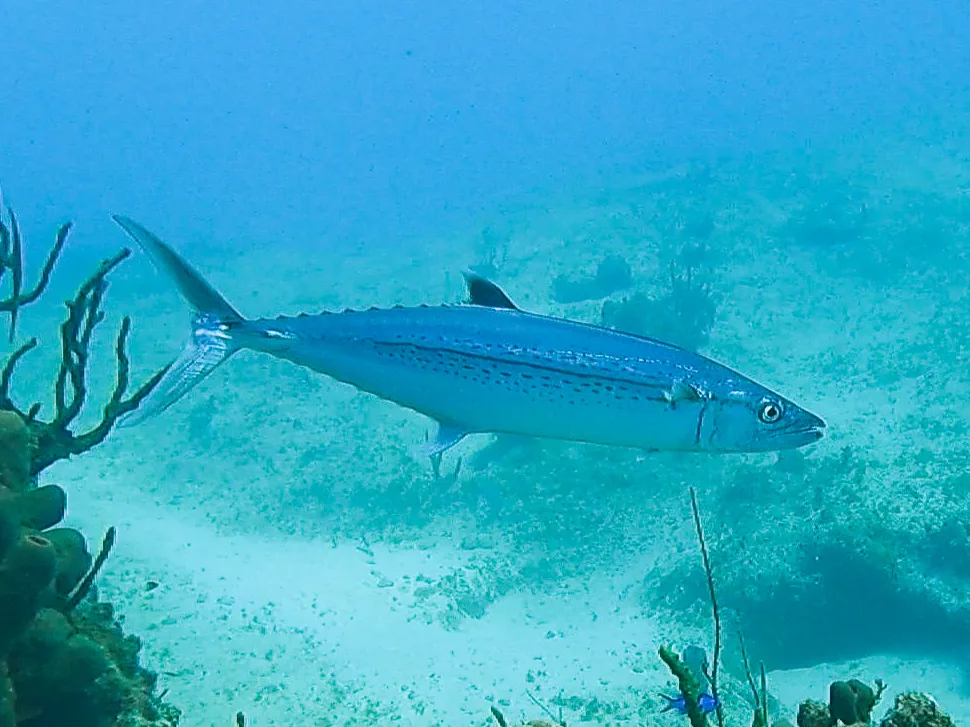
Streamlined, torpedo-shaped mackerel with small scales and no swim bladder; iridescent blue-green back and silvery sides with a single long mid-lateral (bronze) stripe plus rows of yellow-orange streaks and spots; front third of the first dorsal fin black; pectoral fins scaled
- Family
- Scombridae
- IUCN Red List category
- Least Concern
- Size
- Typical adult 45-90 cm (18-35 in); maximum recorded 183 cm TL (72 in) and 7.8 kg. Fish commonly weigh up to about 3.6 kg (8 lb).
- Depth range
- 1-20 m; Published accounts give 0-18 m.
- Habitat
- Reef-associated, oceanodromous species of warm, clear coastal surface waters; most abundant around coral reefs, also over wrecks and ledges; usually in mid-water or near the surface.
- Diet
- Piscivore feeding mainly on clupeoid fishes (herrings such as Harengula, Jenkinsia, Opisthonema) and silversides, plus squid and shrimp.
- Geographic range
- Caribbean: common throughout the Caribbean, Bahamas and Florida; wider Atlantic: western Atlantic from Massachusetts (USA) to Brazil, including the Bahamas, West Indies and Gulf of America
- Maximum weight
- 7.8 kg
- Trophic level
- 4.37
- Vulnerability index
- 61.63
- Human hazard
- Reports of ciguatera poisoning
- Spawning seasonality
- Variable throughout range
- Reproductive mode
- Separate sexes; External fertilization; Eggs or young are not guarded; Eggs scattered in open water or on the substrate
- Common name in Spanish
- Alasana, Carite, Carite chinigua, Carite listado, Carite rey, Carito, Carrite, Pelicán, Pintada, Sierra
- Common name in French
- Thazard atlantique, Thazard franc
02 / NATURAL HISTORY
Field notes
Biology and ecology, shown where information is available for this species.
males mature at about 33-34 cm and females at about 38 cm; Published accounts give length at first maturity of 40.5 cm.
Swift mid-water predator of small schooling fishes and squid on reefs; preyed on by wahoo, sharks, dolphins and diving seabirds.
Usually solitary but occasionally forms schools over reefs and wrecks; fast swimmer (up to about 48 km/h); often approaches divers and snorkelers but rarely comes very close
Broadcast spawner releasing 160,000 to 2.23 million buoyant eggs that hatch into pelagic larvae; spawns offshore April-October off Jamaica and year-round off Florida, Puerto Rico and Venezuela.
Spanish Mackerel (S. maculatus) has spots on the sides but no long mid-lateral stripe or yellow-orange streaks; King Mackerel (S. cavalla) has a lateral line that dips sharply below the second dorsal fin (cero's slopes gradually), unscaled pectoral fins, and a black front dorsal only when young.
LC – Least Concern; taken in minor commercial fisheries and valued as a gamefish
Recorded food groups and items (28)
- nekton
- cephalopods
- squids/cuttlefish
- Atherinidae
- finfish
- bony fish
- Craterocephalus sp.
- Hypoatherina harringtonensis
- Belonidae
- Caranx ruber
- Selar crumenophthalmus
- Harengula clupeola
- Harengula humeralis
- Opisthonema oglinum
- Harengula sp.
- Anchoa sp.
- Engraulidae
- Hemiramphus brasiliensis
- Clepticus parrae
- Labridae
- Liza sp.
- Azurina cyanea
- Chromis multilineata
- Jenkinsia sp.
- Crustacea
- zoobenthos
- benthic crust.
- shrimps/prawns
Reported countries and territories (33)
- Anguilla
- Antigua and Barbuda
- Aruba
- Bahamas
- Barbados
- Belize
- Bermuda
- British Virgin Islands
- Cayman Islands
- Colombia
- Cuba
- Curaçao
- Dominica
- Dominican Republic
- French Guiana
- Grenada
- Guadeloupe
- Guyana
- Haiti
- Jamaica
- Martinique
- Mexico
- Montserrat
- Nicaragua
- Puerto Rico
- Saint Kitts and Nevis
- Saint Lucia
- Saint Vincent and the Grenadines
- Suriname
- Trinidad and Tobago
- Turks and Caicos Islands
- United States Virgin Islands
- Venezuela
TL means total length; SL excludes the tail fin; FL measures to the tail fork. These measurements are not interchangeable.
CARIBBEAN REEF FISH FOUNDATION
From field knowledge
to reef action.
Explore the Foundation’s current conservation and research work.