
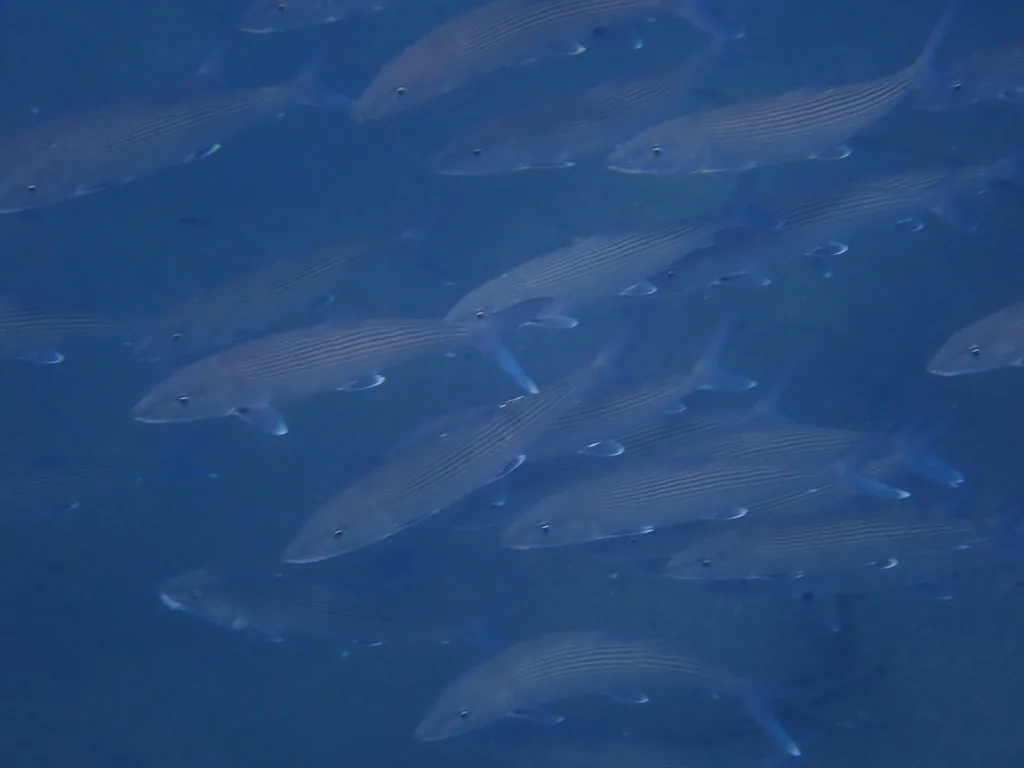
01 / SPECIES PROFILE
Species Overview
Elongate, torpedo-shaped body with a blunt conical snout that overhangs the small underslung mouth; bluish-green back, bright silver sides and belly, with dark streaks between upper scale rows; fins dusky with yellow at the pectoral base; deeply forked tail and no fin spines (dorsal 15-19 soft rays, anal 7-9)
- Family
- Albulidae
- IUCN Red List category
- Near Threatened
- Size
- Typically 30-75 cm (12-30 in); maximum recorded 104 cm TL (41 in) and 10 kg; maturity around 37.5 cm.
- Depth range
- 0-84 m, usually 1-15 m; Published accounts give 0-10 m.
- Habitat
- Shallow coastal waters, intertidal flats, mangroves, bays, estuaries and river mouths over sand, mud, seagrass or rock, moving onto flats with the rising tide and back to deeper water on the falling tide; marine and brackish, amphidromous.
- Diet
- Bottom feeder that roots in sand and mud with its snout and crushes prey with pharyngeal teeth; eats, crabs, shrimp, clams, snails and small fishes such as toadfish.
- Geographic range
- Caribbean, Bahamas and Florida; in the western Atlantic from North Carolina to Brazil including the Gulf, with listing additional warm-sea records worldwide.
- Maximum weight
- 10 kg
- Trophic level
- 3.66
- Vulnerability index
- 39.62
- Human hazard
- Reports of ciguatera poisoning
- Reproductive mode
- Separate sexes; External fertilization; Eggs or young are not guarded; Eggs scattered in open water or on the substrate
- Common name in Spanish
- Borrigero, Carajo, Colvino, Conejo, Gatico, Gato, Inliaula, Inllaulá, Liguija, Lisa saltona, Macabi, Macabí, Macabi de hebra, Macabi Lebranche, Macabi ratón, Macabie, Macaco, Parra, Peje gato, Pejegato, Piojo, Ratón, Ratón de mar, Sanducha, Zorro
- Common name in French
- Albule, Banane, Banane de mer, Sorte de mulet, Tarpon
02 / NATURAL HISTORY
Field notes
Biology and ecology, shown where information is available for this species.
Larva is a transparent, ribbon-like leptocephalus, a stage it shares with tarpons and eels; juveniles show about nine dark crossbands that fade with growth, and adult streaking appears above about 7.5 cm (3 in).
Benthic predator of flats invertebrates that links shallow flats food webs; preyed on by sharks and barracuda, relying on speed to escape.
Schools, sometimes up to about 100 fish, while large adults tend to be solitary; very wary and easily spooked; tracks the tides on and off the flats; can gulp air into its lung-like swim bladder to cope with low-oxygen water
Spawns in open, deep water with pelagic eggs; spawning reported year-round with a November-June peak in the Florida Keys; leptocephalus larvae.
Bonefish (A. vulpes) is characterized by a mouth that does not reach under the eye and the absence of fin filaments. Shafted Bonefish (A. nemoptera) is distinct for having a mouth reaching under the eye and long filaments on the dorsal and anal fins. Senegal Bonefish (A. goreensis) shares the lack of filaments and short mouth structure with A. vulpes.
NT – Near Threatened; concerns include post-release mortality, gut hooking, shark predation on hooked fish and poor water quality; in Florida commercial sale is prohibited and recreational catches must be released (FWC rules,).
Recorded food groups and items (11)
- nekton
- cephalopods
- squids/cuttlefish
- finfish
- bony fish
- zoobenthos
- benthic crust.
- shrimps/prawns
- Aliger gigas
- mollusks
- gastropods
Reported countries and territories (38)
- Anguilla
- Antigua and Barbuda
- Aruba
- Bahamas
- Barbados
- Belize
- Bermuda
- Bonaire, Sint Eustatius and Saba
- British Virgin Islands
- Cayman Islands
- Colombia
- Costa Rica
- Cuba
- Curaçao
- Dominica
- Dominican Republic
- French Guiana
- Grenada
- Guadeloupe
- Guatemala
- Guyana
- Haiti
- Honduras
- Jamaica
- Martinique
- Mexico
- Montserrat
- Nicaragua
- Panama
- Puerto Rico
- Saint Kitts and Nevis
- Saint Lucia
- Saint Vincent and the Grenadines
- Suriname
- Trinidad and Tobago
- Turks and Caicos Islands
- United States Virgin Islands
- Venezuela
TL means total length; SL excludes the tail fin; FL measures to the tail fork. These measurements are not interchangeable.
CARIBBEAN REEF FISH FOUNDATION
From field knowledge
to reef action.
Explore the Foundation’s current conservation and research work.