
01 / SPECIES PROFILE
Species Overview
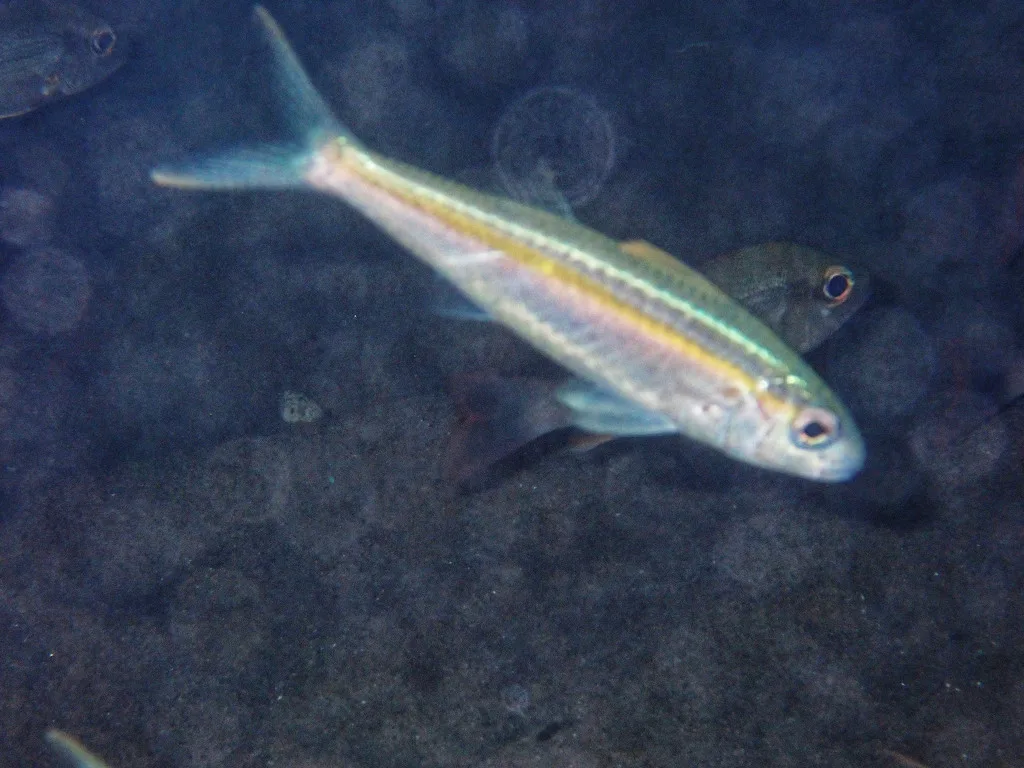
Elongate, spindle-shaped body with a deeply forked tail and highly protrusible mouth; yellow snout, blue-green back shading to bluish-white below, a broad greenish stripe from eye to tail with 3–4 narrow dark stripes above and below; tail lobes black with gray edges; dorsal fin XIV–XV,10 with dorsal fins close together, anal II,9; no teeth
- Family
- Haemulidae
- IUCN Red List category
- Least Concern
- Size
- Commonly 12–18 cm (5–7 in); common length 18 cm TL (7 in); maximum 23 cm TL (9 in).
- Depth range
- 10–45 m; 15–50 m; recorded to 105 m (mexican-fish.com).
- Habitat
- Open water near reefs, often around oceanic islands and sometimes over coral heads; forms large schools in the water column.
- Diet
- Zooplanktivore: picks zooplankton from the water column by day; also small mid-water fishes, mysids, small shrimp and larvae, feeding on benthic organisms at night.
- Geographic range
- Caribbean, Bahamas, Florida, Gulf of Mexico and Bermuda; western Atlantic from southern Florida and the Bahamas to northern South America including the Antilles.
- Trophic level
- 4
- Vulnerability index
- 27.61
- Human hazard
- Harmless
- Reproductive mode
- Separate sexes; External fertilization; Monogamy; Eggs or young are not guarded; Eggs scattered in open water or on the substrate
- Common name in Spanish
- Boga
- Common name in French
- Boga
02 / NATURAL HISTORY
Field notes
Biology and ecology, shown where information is available for this species.
Juveniles are deeper-bodied than adults
Planktivorous schooling fish that transfers plankton energy to reef predators; juveniles are prey for red hind and invasive lionfish.
Schools in large groups near reefs; fast-swimming water-column fish; feeds on zooplankton during the day and on benthic and mid-water prey at night; uses its protrusible mouth to reach prey before suction-feeding.
Oviparous with distinct pairing during breeding; otherwise poorly studied.
Bonnetmouth (Emmelichthyops atlanticus): 11–12 dorsal spines and a wide gap between dorsal fins; Bronzestripe grunt (Haemulon boschmae): 13–14 dorsal spines and a dark spot at the tail base (Boga has 14–15 spines and closely set dorsal fins).
LC – Least Concern; minor commercial fishery and occasionally used as bait
Recorded food groups and items (2)
- zooplankton
- jellyfish/hydroids
Reported countries and territories (28)
- Anguilla
- Antigua and Barbuda
- Aruba
- Bahamas
- Barbados
- Belize
- Bermuda
- British Virgin Islands
- Cayman Islands
- Colombia
- Cuba
- Curaçao
- Dominica
- Dominican Republic
- Grenada
- Guadeloupe
- Haiti
- Jamaica
- Martinique
- Montserrat
- Puerto Rico
- Saint Kitts and Nevis
- Saint Lucia
- Saint Vincent and the Grenadines
- Trinidad and Tobago
- Turks and Caicos Islands
- United States Virgin Islands
- Venezuela
TL means total length; SL excludes the tail fin; FL measures to the tail fork. These measurements are not interchangeable.
CARIBBEAN REEF FISH FOUNDATION
From field knowledge
to reef action.
Explore the Foundation’s current conservation and research work.