
01 / SPECIES PROFILE
Species Overview
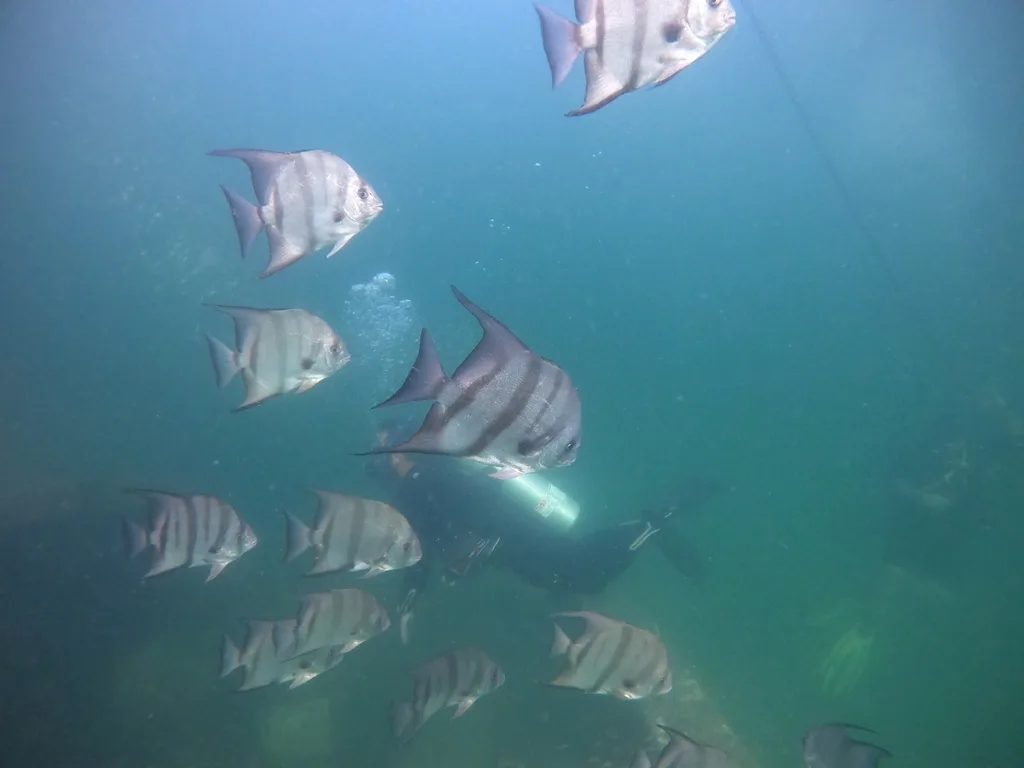
Very deep, compressed, disk-shaped body with a blunt snout and small mouth; silvery with 4-6 bold black vertical bands that fade in larger fish; second dorsal and anal fins have tall front lobes; dorsal fin IX, 21-24; anal fin III, 17-18
- Family
- Ephippidae
- IUCN Red List category
- Least Concern
- Size
- Typical adult 30-60 cm [12-24 in]; common length 50.4 cm TL, maximum 91 cm TL [36 in], max weight 9.0 kg.
- Depth range
- 3-21 m; 3-35 m.
- Habitat
- Shallow coastal marine and brackish waters: mangroves, sandy beaches, wrecks and harbors; juveniles common in estuaries.
- Diet
- Benthic invertebrates (crustaceans, mollusks,, sponges, cnidarians) and plankton; also nibbles jellyfish tentacles, with feeding peaking around midday.
- Geographic range
- Caribbean, Bahamas, Florida, Gulf of America and Brazil; Western Atlantic from Massachusetts and the northern Gulf of Mexico to Rio Grande do Sul, Brazil, including Bermuda.
- Maximum weight
- 9 kg
- Trophic level
- 3.5
- Vulnerability index
- 51.99
- Human hazard
- Reports of ciguatera poisoning
- Spawning seasonality
- one clear seasonal peak per year
- Reproductive mode
- Separate sexes; External fertilization; Eggs or young are not guarded; Eggs scattered in open water or on the substrate
- Common name in Spanish
- Chabela, Chiririca, Chirivita chiva, Isabelita, Luna, Mochila, Mono, Mono colorao, Paguala, Paguara, Pagüara, Palaguala, Palometa, Sabaleta
- Common name in French
- Carangue à slime, Disque portugais, Disque portuguais, Paoua
02 / NATURAL HISTORY
Field notes
Biology and ecology, shown where information is available for this species.
Juveniles are dark brown to black with lighter mottling and drift tilted on their side in very shallow water, mimicking dead leaves, debris or mangrove pods. Adults silvery with fading bars. Both sexes mature at about one year; Lm 12 cm.
Bottom-feeding invertebrate predator; prey for sharks such as the smalltail shark and for large fishes such as tripletail.
Adults form large schools of up to about 500 fish and often approach or circle divers; feeding is diurnal, peaking at midday.
Spawns May-September on the inner U.S. continental shelf; a female can release up to about one million small, buoyant eggs per season, which hatch in about 24 hours.
Sheepshead (Archosargus probatocephalus) has similar bands but a longer snout, less rounded body and smaller soft dorsal/anal fins; angelfishes have one continuous dorsal fin whereas spadefish have separate spiny and soft dorsals.
LC – Least Concern. notes harvest levels are unknown, its schooling and spawning aggregations make it potentially vulnerable to overfishing, and there is no specific management plan for the species.
Recorded food groups and items (16)
- Caprella penantis
- zoobenthos
- benthic crust.
- amphipods
- Ericthonius punctatus
- Ericthonius brasiliensis
- Jassa falcata
- Obelia sp.
- cnidarians
- Eudendrium sp.
- mollusks
- worms
- Stomolophus meleagris
- zooplankton
- jellyfish/hydroids
- other planktonic invertebrates
Reported countries and territories (30)
- Antigua and Barbuda
- Aruba
- Bahamas
- Barbados
- Belize
- Bermuda
- Colombia
- Costa Rica
- Cuba
- Curaçao
- Dominica
- Dominican Republic
- French Guiana
- Grenada
- Guatemala
- Guyana
- Haiti
- Honduras
- Jamaica
- Martinique
- Mexico
- Nicaragua
- Panama
- Puerto Rico
- Saint Lucia
- Saint Vincent and the Grenadines
- Suriname
- Trinidad and Tobago
- United States Virgin Islands
- Venezuela
TL means total length; SL excludes the tail fin; FL measures to the tail fork. These measurements are not interchangeable.
CARIBBEAN REEF FISH FOUNDATION
From field knowledge
to reef action.
Explore the Foundation’s current conservation and research work.